
Coat of arms of Argentina
National emblem of Argentina featuring the Sun of May, clasped hands, a pike with a Phrygian cap, laurel wreath and blue-and-white fields; rooted in the 1813 seal and standardized in 1944.
Overview
The coat of arms of Argentina is the national emblem that represents the Argentine Republic and its republican values. Its present composition and proportions were standardized in the 20th century, while its visual roots trace back to a seal adopted by the General Constituent Assembly of 1813. The emblem assembles classical symbols—sun, liberty cap, laurel wreath and joined hands—that were widely used in the era of Latin American independence to express ideas of liberty, unity and civic honor.
Image gallery
2 Images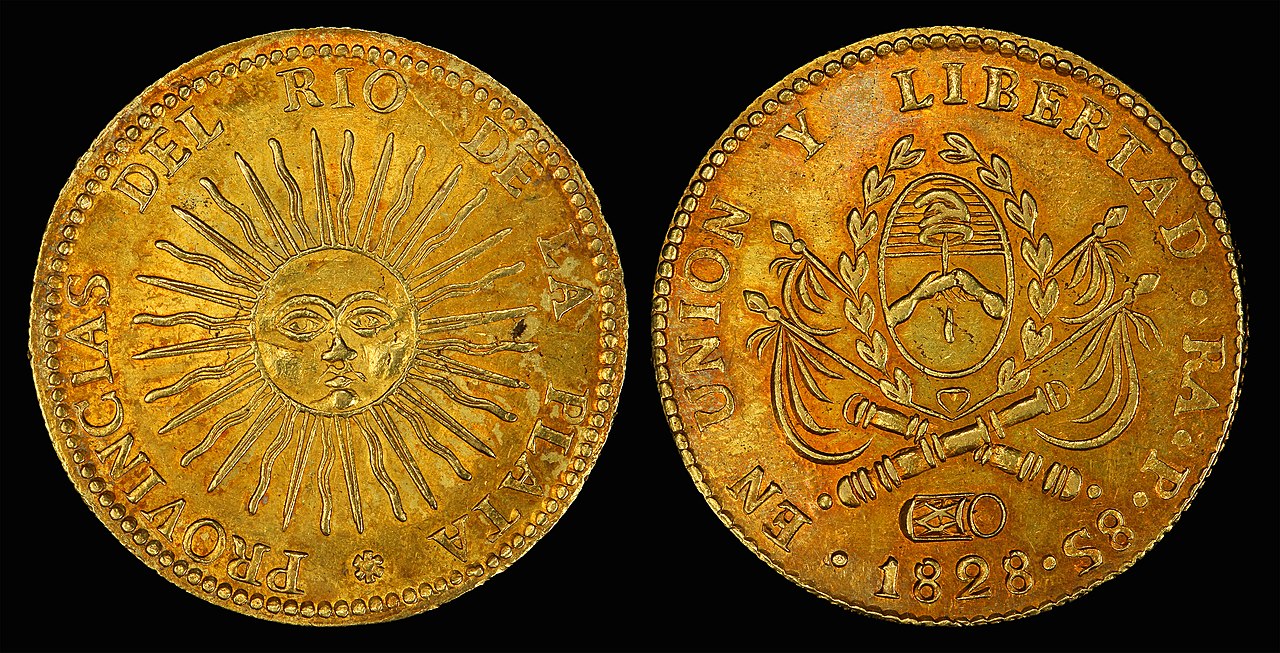

Design and primary elements
The central device is an oval shield divided horizontally into two fields: a blue upper half and a white lower half. Above the shield rises the Sun of May, a golden radiant sun that also appears on the national flag. At the center two hands clasp each other, holding a long pike topped by a Phrygian (liberty) cap. A laurel wreath surrounds the shield and is tied at its base with a ribbon in the national colors. For an official summary and images consult the national emblem page: national emblem page.
- Sun of May: A radiant sun placed above the shield, recalling the May Revolution (1810) and symbolizing the birth of the nation. See the Sun of May for more: Sun symbol.
- Clasped hands: Represent the union of the provinces and mutual agreement among citizens, an image of civic concord.
- Pike and Phrygian cap: The pike conveys readiness to defend freedom; the Phrygian cap is a classical emblem of liberty and emancipation. For background on the cap: Phrygian cap meaning.
- Blue and white: The shield's colors echo the national flag; the blue is often associated with the sky and the white with the Río de la Plata. See the flag: flag overview and regional context: Rio de la Plata context.
- Laurel wreath: A traditional sign of victory, honor and civic achievement.
History and evolution
The emblem's origin lies in the early independence period. In 1813 the General Constituent Assembly approved a seal that grouped many of the same motifs used today; those motifs were drawn from classical and revolutionary iconography current in the Atlantic world. Over the 19th and early 20th centuries the emblem appeared in numerous stylistic variants on coins, official documents, provincial seals and military insignia. Although no single designer is definitively credited with the modern composition, the arrangement was formally standardized and officially adopted in its present proportions in the 20th century.
Legal status, uses and variants
The coat of arms is an official national symbol used by central authorities and appears on public buildings, official documents, passports, medals and currency. Regulations usually specify correct colors, proportions and permitted uses; simplified or stylized adaptations exist for specific purposes such as seals, logos and military devices. Provincial governments and institutions sometimes produce authorized variants for local use, but the core elements remain consistent to preserve recognizability and symbolic meaning.
Symbolic interpretation and comparative context
Each element has a broadly accepted civic interpretation: the Sun of May evokes the beginning of the nation, the joined hands indicate political unity, the pike with a liberty cap asserts the value of liberty defended by the people, and the laurel wreath celebrates triumph and honor. These motifs are part of a common visual vocabulary shared across many Latin American emblems from the independence era, where liberty caps, suns and laurels frequently appear to express similar ideals.
Usage notes and notable observations
Artistic renderings of the emblem have varied through time: some historic versions emphasize more naturalistic hands and sunrays while official government reproductions fix specific hues and proportions. The precise origin of particular stylistic choices is not always documented, and historians treat the emblem as the result of evolving practice rather than the work of a single, clearly identified designer. For official reproductions, specifications and historical documentation consult: national emblem page and related references provided by government archives.
Further reading
The coat of arms remains a living symbol used in ceremonies, official imagery and public spaces, and it continues to be a subject of study in works on iconography and national identity. For complementary information, see general materials on the Sun of May (Sun), the national flag (Flag), the liberty cap (Phrygian cap) and regional context around the Río de la Plata (Rio de la Plata).
Related articles
Author
AlegsaOnline.com Coat of arms of Argentina Leandro Alegsa
URL: https://en.alegsaonline.com/art/21240
Sources
- national-symbol.com : "National country symbols of Argentina"
- infoleg.mecon.gov.ar : "Que el Escudo, la Bandera, el Himno y su letra son los símbolos de la soberanía de la Nación"