
Chappaquiddick (film) — 2017 drama about the Ted Kennedy incident
2017 American political drama directed by John Curran, starring Jason Clarke and Kate Mara, dramatizing the 1969 Chappaquiddick incident and its political consequences; U.S. release April 6, 2018.
Overview
Chappaquiddick, released in some territories as The Senator, is a 2017 American dramatic film that examines the events and aftermath of the 1969 Chappaquiddick incident. The picture was directed by John Curran (director) from a screenplay by Taylor Allen and Andrew Logan (screenwriters). It stars Jason Clarke (Jason Clarke) as Senator Ted Kennedy and Kate Mara (Kate Mara) as Mary Jo Kopechne, and concentrates on the night of the accident, subsequent decisions, and the broader political ramifications.
Image gallery
2 Images
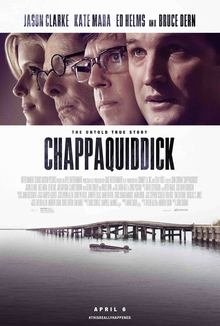
Cast and production
The supporting ensemble includes Ed Helms (Ed Helms), Bruce Dern (Bruce Dern), Jim Gaffigan (Jim Gaffigan), Clancy Brown (Clancy Brown), and Olivia Thirlby (Olivia Thirlby). The production involved research into public records, contemporary reporting and memoir material; producers and the creative team described an effort to reconstruct the events while dramatizing private conversations and decisions. The film was distributed in the United States by Entertainment Studios and opened in U.S. cinemas on April 6, 2018 (release information).
Historical context and subject
The story dramatizes the 1969 car accident on Chappaquiddick Island, Massachusetts, involving Senator Ted Kennedy and resulting in the death of Mary Jo Kopechne. The incident became a sustained public controversy, involving legal inquiry, media attention and questions about political accountability. The film attempts to lay out a timeline of events and to portray the responses of Kennedy, his advisers and his family, while acknowledging areas where the historical record has gaps or differing interpretations (Mary Jo Kopechne).
Filmmaking and research
Filmmakers working on historical dramas often balance dramatization with documentary sources; in this case the writers and director consulted archival news accounts, court transcripts and publicly available testimony as part of their research. Cinematic choices—camera placement, period production design and editing—aim to evoke the late 1960s and the claustrophobic atmosphere around a political crisis. Interviews with participants and with historians informed the production, though the film does not present itself as a definitive documentary record (production notes).
Themes and approach
Rather than relying on sensationalism, the film foregrounds themes of power, responsibility and crisis management. It examines how public image and private choices interact when a prominent public figure faces moral and legal scrutiny. The screenplay pays particular attention to the dynamics within a political family and the legal and media mechanisms that shaped public perception (critical themes).
Reception and debate about accuracy
On release, Chappaquiddick received generally positive notices for its performances—particularly for the portrayals of the two leads—and for its restrained tone. Critics commended the film's ability to sustain tension without overt melodrama, while some commentators raised questions about selective emphasis and what a dramatization chooses to include or omit. Such debates are common for films that tackle contested or politically charged historical episodes (reviews and analysis).
Release and significance
The film's release renewed public interest in the Chappaquiddick episode and contributed to broader discussions about how historical films handle evidence and perspective. It has been used by viewers and commentators as a starting point for renewed examination of the original incident and of the ways media and politics intersect when private tragedy involves public figures (distribution and release).
Further reading and resources
- Director profile
- Screenwriters' background
- Lead actor information
- Lead actress information
- Supporting cast
- Supporting cast
- Supporting cast
- Supporting cast
- Supporting cast
- Release and distribution details
- Biographical context on Mary Jo Kopechne
- Production and research notes
- Critical essays and themes
- Critical reception and coverage
- Distribution and release history
- Kennedy family context
The film remains a notable recent example of how contemporary cinema revisits 20th-century political events, inviting viewers to consider both the human and institutional dimensions of a moment that has continued to provoke public interest.
Related articles
Author
AlegsaOnline.com Chappaquiddick (film) — 2017 drama about the Ted Kennedy incident Leandro Alegsa
URL: https://en.alegsaonline.com/art/18616
Sources
- bbfc.co.uk : "The Senator (2018)"
- indiewire.com : "'Chappaquiddick' Moves Out of the Crowded Awards Season — Exclusive"
- editorial.rottentomatoes.com : "A Quiet Place and Blockers Are Certified Fresh"