
CFA franc (West and Central African currencies)
The CFA franc is a currency used in two African monetary unions. It exists in West and Central versions, shares a fixed parity, and is issued by regional central banks under historical ties to France.
Overview
The CFA franc is the name given to two closely linked currencies used in parts of West and Central Africa. The abbreviation CFA originates from French: Communauté Financière d'Afrique or Communauté Financière d'Afrique, referring to a financial community of states. Although there are two separate monetary zones with different issuing authorities, the two CFA francs have been maintained at the same value and are pegged to the euro. The West African version circulates in a group of Sahel and coastal states while the Central African version is used in several countries of the central African region.
Image gallery
2 Images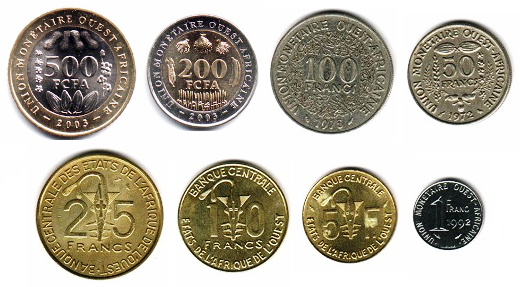

Member states and issuing authorities
The two currency zones are administered by different regional central banks. The West African CFA franc is issued by the Central Bank of West African States (BCEAO); its users include:
- Benin
- Burkina Faso
- Guinea-Bissau
- Côte d'Ivoire
- Mali
- Niger
- Sénégal
- Togo
The Central African CFA franc is issued by the Bank of Central African States (BEAC) and circulates in Cameroon, Central African Republic, Chad, Republic of the Congo, Equatorial Guinea and Gabon.
History and institutional ties
The CFA franc was established in 1945 after World War II as part of the monetary arrangements of French colonial territories. It originally had a fixed link to the French franc and, after the introduction of the euro, to the euro. Historically the arrangement included a French guarantee of convertibility and arrangements for part of member states' foreign reserves to be held with the French public treasury. Over time regional central banks assumed responsibility for issuing banknotes and managing monetary operations for their members.
Function, codes and circulation
Although the West and Central CFA francs are separate currencies with distinct ISO codes (commonly referred to as XOF for West Africa and XAF for Central Africa), they have been maintained at an equal parity and are both pegged to the euro. Banknotes and coins issued by BCEAO and BEAC are legal tender within their respective zones and facilitate trade and price stability within those regions.
Uses, advantages and criticisms
Supporters credit the CFA franc with helping to keep inflation relatively low and providing monetary stability and predictability for trade and investment. Critics argue that the arrangement limits national monetary policy autonomy and perpetuates economic dependence stemming from colonial-era ties. Proposals and reforms have been discussed to change the denomination, governance or backing of the currency; for example, leaders of some West African states announced plans for reforms and a new regional unit, but implementation has been gradual and contested.
Notable distinctions and further reading
Key points to remember are that the two CFA zones are distinct in governance yet share a fixed relationship to the euro, that their currencies are commonly called the CFA franc and identified by the codes XOF and XAF, and that each zone issues its own banknotes and coins. For official information on the West African currency see the BCEAO page: West African CFA franc, and for the Central African currency consult the BEAC information: Central African CFA franc.
Related articles
Author
AlegsaOnline.com CFA franc (West and Central African currencies) Leandro Alegsa
URL: https://en.alegsaonline.com/art/18279
Sources
- bceao.int : bceao.int/
- home.earthlink.net : home.earthlink.net/~wburson/Latest.htm