
Carbon copy (cc): paper duplicates and the legacy in modern messaging
A carbon copy originally described a duplicate made with carbon paper placed between sheets; its abbreviation “cc” survives in mail and email to indicate additional recipients.
Overview
A carbon copy is a duplicate of a written or typed document produced by placing a sheet of carbon paper between two or more sheets of writing paper. When pressure is applied to the top sheet by a pen, pencil or typewriter element, the coating on the carbon transfers ink or pigment to the underlying sheet and reproduces the impression. The practice gave rise to the abbreviation "cc" (carbon copy), which remains in use today as a notation for sending copies of messages to additional recipients.
Image gallery
4 Images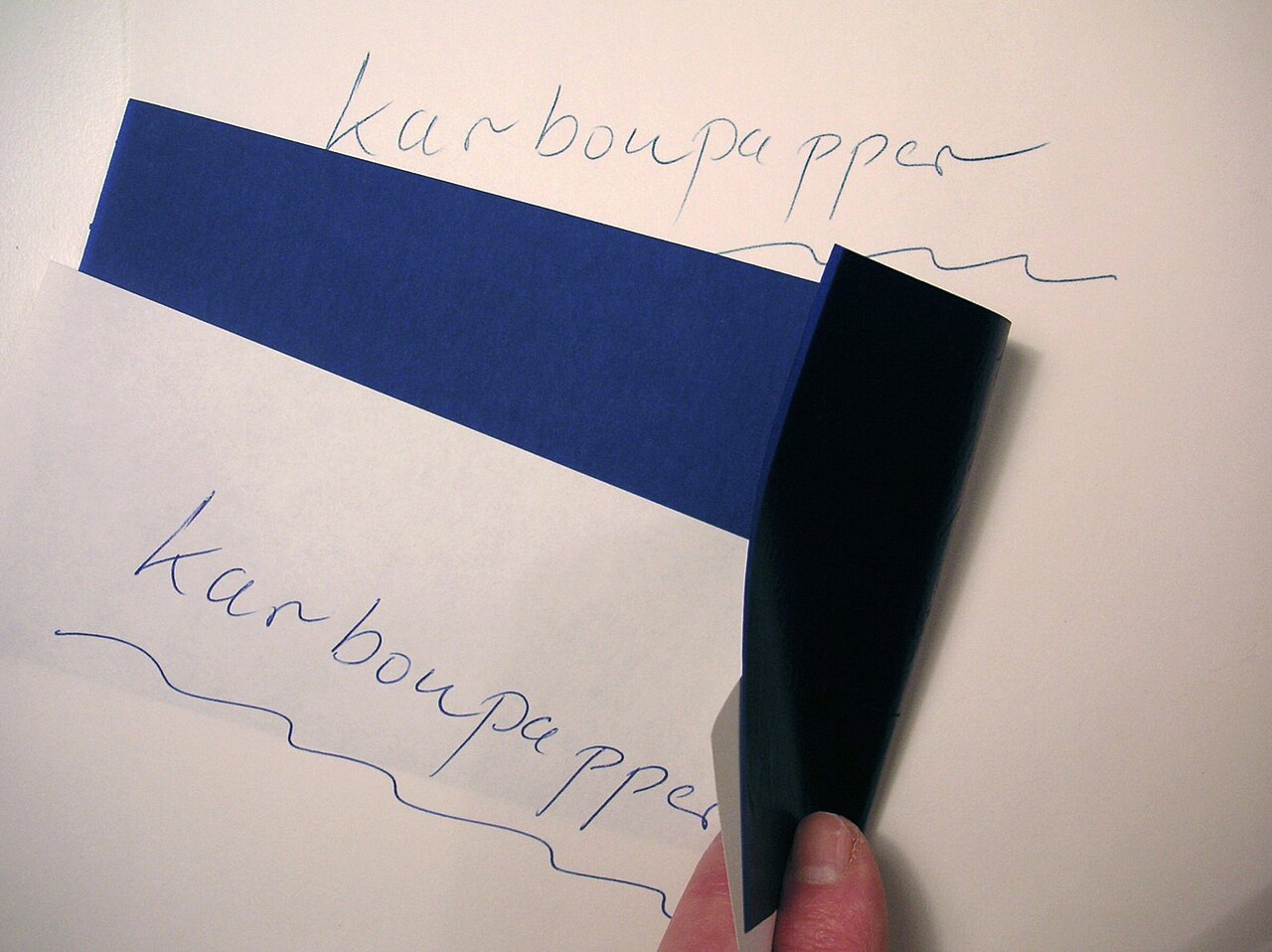


How it works and typical materials
Traditional carbon paper consists of a thin backing coated on one side with a pigmented or inked compound that is slightly waxy or oily so it can transfer under pressure. Only the coated side faces the blank sheet to receive the impression. By inserting multiple layers of carbon paper between successive sheets, users could create several simultaneous copies; however, readability and clarity diminish with each additional layer.
History and development
Carbon copying emerged in the 19th and early 20th centuries as a practical way to make duplicates before affordable photocopying and digital reproduction. It became especially important with the widespread use of typewriters and business correspondence. Over time, specialised multi-part forms and alternatives were developed, including "no carbon required" (NCR) papers that used microencapsulated inks or pressure-sensitive coatings to avoid loose carbon sheets.
Uses and importance
Carbon copies were widely used for business records, invoices, receipts and any situation where an original and one or more copies were needed simultaneously. They provided immediate working copies without the delay or expense of separate transcription. In legal and administrative settings a carbon copy often served as an authoritative duplicated record, though legibility and preservation could be problematic.
Legacy in electronic messaging
The notation "cc" was carried over into postal and then electronic correspondence. In manual letter-writing and typewritten letters, writers would append "cc:" followed by names to indicate who received carbon copies. In contemporary email systems the "Cc" field sends identical messages to additional recipients whose addresses are visible to all other recipients. This contrasts with "Bcc" (blind carbon copy), which hides the list of those copied.
Notable distinctions and modern context
- Cc — public copy visible to all recipients.
- Bcc — blind copy; recipients are concealed from others.
- NCR and digital replacement — many workflows now use carbonless forms, scanners, or digital records, reducing reliance on physical carbon paper.
Although physical carbon papers are much less common today, the concept of a carbon copy endures as a metaphor for identical duplication and as a functional feature in electronic communications. The term reminds users of the older mechanical methods that shaped modern practices for record keeping and message distribution.
Related articles
Author
AlegsaOnline.com Carbon copy (cc): paper duplicates and the legacy in modern messaging Leandro Alegsa
URL: https://en.alegsaonline.com/art/16871