
Buprestidae — jewel beetles (metallic wood‑borers)
Buprestidae, or jewel beetles, are a large family of often metallic, wood‑boring beetles. Larvae tunnel in wood and some species are important forest pests; adults are noted for iridescent, structural colors.
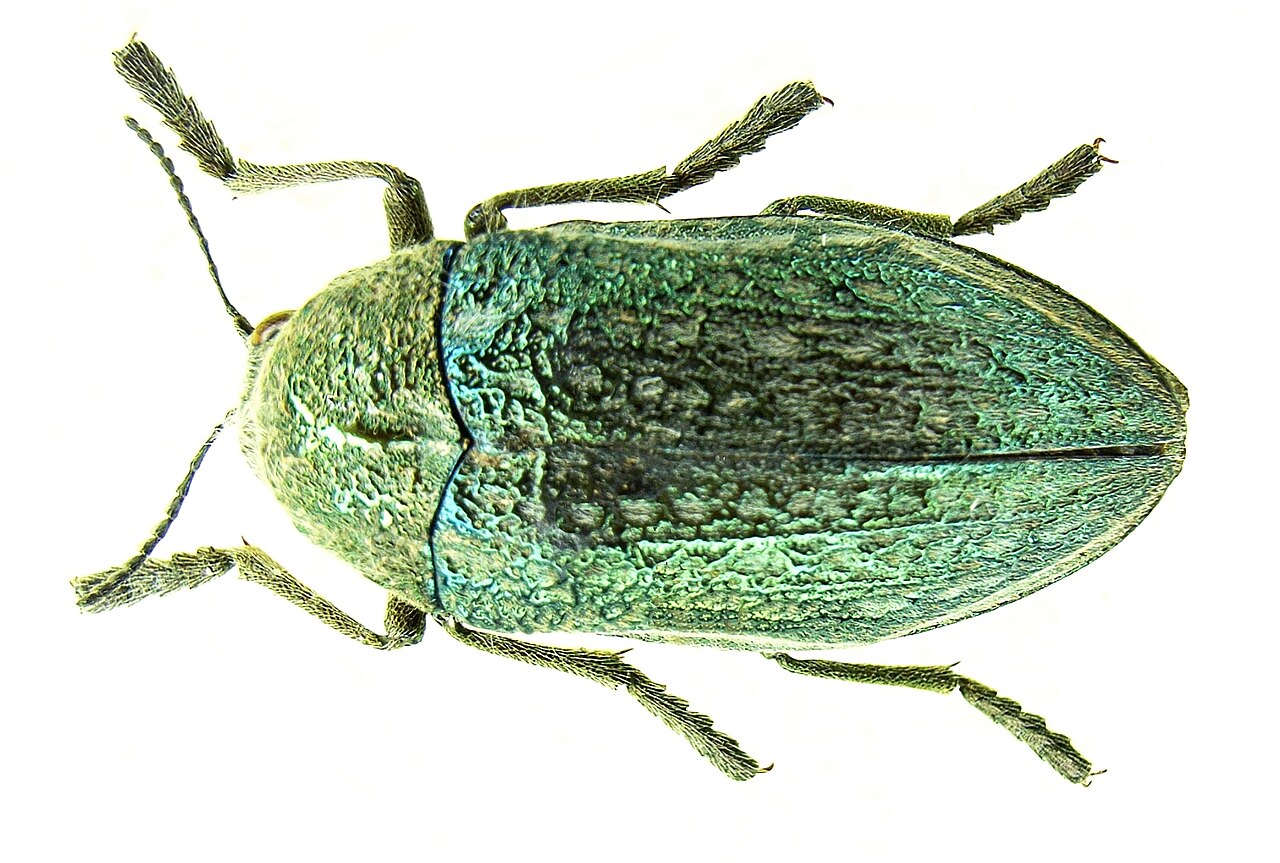
The family Buprestidae belongs to the order Coleoptera and is commonly referred to as jewel beetles or metallic wood‑boring beetles. Members of this family are renowned for their often bright, metallic sheen, produced by microscopic surface structures rather than pigment alone; this form of structural coloration gives many species a gem‑like appearance. Buprestids range widely in size and shape but are typically elongate, somewhat flattened or bullet‑shaped beetles with hard, sculptured elytra.
Image gallery
10 Images


Morphology
Adults usually have a compact, rigid body and may show vivid greens, blues, bronzes or copper tones. The head is often retracted under the pronotum, and the elytra may be marked with ridges, pits or smooth glossy surfaces. Larvae are commonly called "flat‑headed borers"; they are legless or poorly legged, with the prothorax broadened and flattened anteriorly — an adaptation for tunnelling beneath bark or through wood.
Life cycle and habits
Buprestidae follow the typical beetle life cycle of egg, larva, pupa and adult. Females lay eggs in bark crevices, on stems or in wounds; emerging larvae bore into cambium, sapwood or heartwood and create feeding galleries as they develop. Larval development may take from one year to several years depending on species and host. Adults often visit foliage, flowers or tree trunks to feed and mate, and many species are active in sunlight. Certain taxa are attracted to freshly killed, stressed, or recently burned trees and can be among the first insects to colonize damaged wood.
Diversity, distribution and fossil record
Buprestidae are globally distributed, with greatest diversity in warm temperate and tropical regions. Modern treatments recognize roughly 15,000 described recent species in about 450 genera, with new species still described by taxonomists. The family also has a fossil record: nearly 100 fossil species have been described, indicating a long evolutionary history and past diversity in various ecosystems.
Ecological and economic importance
Ecologically, buprestid larvae play a role in the decomposition and recycling of dead wood and in nutrient cycling within forests. Economically, several species are important pests of living trees and timber. A widely cited example is the emerald ash borer (Agrilus planipennis), an invasive species that has caused severe mortality of ash trees in parts of North America. Because of such impacts, some buprestids are subject to quarantine, monitoring and control programs in forestry and urban tree management.
Human interactions and study
The striking appearance of many jewel beetles has led to their use in traditional ornamentation and collecting; iridescent elytra have been used in jewelry and decorative arts in various cultures. Scientifically, the optical properties of buprestid exoskeletons are studied for applications in biomimicry and materials science. Entomologists study their taxonomy, host associations and life histories to inform conservation and pest management.
Identification and resources
- Field characters: look for elongate, hard bodies, metallic sheen and flattened head in larvae.
- Behavioral cues: adults often found on sunny tree trunks, foliage or flowers; some species attracted to burned wood.
- Management: monitoring of susceptible tree species and rapid response to infestations are important for forest health.
For taxonomic overviews, species lists and further reading, consult family‑level treatments and specialist databases: family overview, order summaries at Coleoptera resources, general common name pages such as jewel beetles (common names), anatomical notes on exoskeletal coloration, diversity statistics like species counts and genera lists, and paleontological records at fossil summaries. These links point to specialist references and databases maintained by entomologists and natural history institutions.
Related articles
Author
AlegsaOnline.com Buprestidae — jewel beetles (metallic wood‑borers) Leandro Alegsa
URL: https://en.alegsaonline.com/art/15361