
Caecilian (order Gymnophiona)
Caecilians are limbless, elongated amphibians (order Gymnophiona) adapted for a burrowing lifestyle; often mistaken for worms or snakes, they play specialized roles in tropical ecosystems and are little known to science.
Caecilians are a group of amphibians placed in the order often called Gymnophiona. They are characterized by an elongated, limbless body and reduced or absent eyes, adaptations associated with a predominantly underground or aquatic life. Because many species live hidden beneath soil or leaf litter, caecilians remain less familiar to the public and to scientists than frogs or salamanders.
Image gallery
10 Images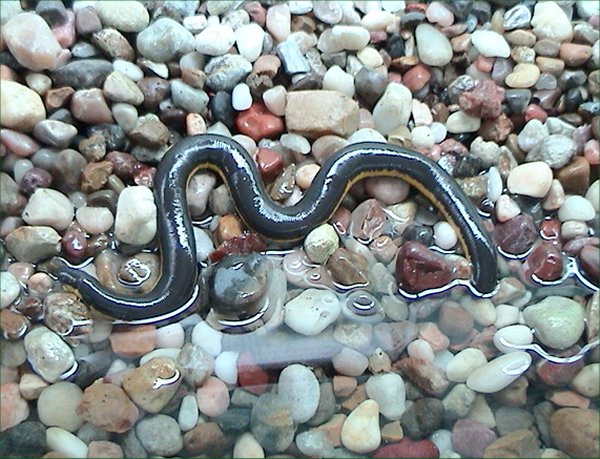


Physical characteristics
Most caecilians have smooth, annulated skin that can resemble the rings of an earthworm or the scales of a snake in overall shape, but they are amphibians rather than invertebrates or reptiles. Many species have a skull adapted for pushing through soil, a compact body, and sensory tentacles on the head that help detect chemicals and vibrations. Reproductive modes vary: some lay eggs while others give birth to live young; parental care occurs in several species.
Distribution and habitat
Caecilians are found mainly in tropical regions of South and Central America, Africa, and Asia. They occupy a range of habitats from moist forest soils to freshwater bodies. Their secretive habits mean they are often discovered only when soil is turned or by targeted surveys, which contributes to gaps in knowledge about their true diversity and ranges.
Behavior and ecology
Many species are specialized burrowers, moving through earth and leaf litter. Some resemble earthworms in shape or are superficially like snakes, but their anatomy and life history are distinct. Others live in water or in subterranean streams. Caecilians feed on soil invertebrates such as worms, insects, and small crustaceans. Their role as predators and soil engineers can influence nutrient cycling and soil structure.
Taxonomy and research
The order is commonly cited under the names Gymnophiona or Apoda; taxonomic relationships among families are an active area of study. Because of their hidden lifestyles, many species were described relatively recently, and new discoveries continue to refine understanding of their evolution and diversity. For more on classification see Gymnophiona resources.
Conservation and notable facts
Caecilians face threats similar to other amphibians: habitat loss, pollution, and disease. Their secretive habits make assessing population trends difficult. Some species are locally abundant, while others may be rare or declining. Researchers emphasize the need for targeted surveys and habitat protection. Additional background on their burrowing adaptations and ecology is available via links about their fossorial behavior: burrowing ecology.
- Key distinctions: amphibian anatomy, sensory tentacles, varied reproduction.
- Common confusion: appearance may suggest worms or snakes but caecilians are a distinct amphibian lineage.
Questions and answers
Q: What are Caecilians?
A: Caecilians are an order of amphibians.
Q: What is another name for Caecilians?
A: Caecilians are sometimes called Gymnophiona or Apoda.
Q: What do Caecilians look like?
A: Most Caecilians look like either earthworms or snakes.
Q: Where do Caecilians burrow?
A: Caecilians burrow in the ground.
Q: Why are Caecilians the least explored order of amphibians?
A: Caecilians are the least explored order of amphibians because they burrow in the ground.
Q: Are Caecilians commonly found as pets?
A: No, Caecilians are not commonly found as pets.
Q: Are Caecilians generally well-known to the general public?
A: No, Caecilians are not generally well-known to the general public.
Related articles
Author
AlegsaOnline.com Caecilian (order Gymnophiona) Leandro Alegsa
URL: https://en.alegsaonline.com/art/15937
Sources
- species.wikimedia.org : Gymnophiona
- commons.wikimedia.org : Gymnophiona
- bbc.co.uk : bbc.co.uk/news/science-environment-17100578
- dx.doi.org : "Phylogeny of caecilian amphibians (Gymnophiona) based on complete mitochondrial genomes and nuclear RAG1"
- journals.uchicago.edu : "Initial diversification of living amphibians predated the breakup of Pangaea"