
Bulguksa: The Historic Buddhist Temple of Gyeongju
Bulguksa is an 8th‑century Korean Buddhist temple in Gyeongju, South Korea, noted for its stone pagodas, ornamental bridges and gilt‑bronze Buddhas; a UNESCO World Heritage Site since 1995.
Overview
Bulguksa is a major temple of Korean Buddhism located in the historical city of Gyeongju, South Korea. Founded in the Silla period, the complex exemplifies classical Korean temple planning and stone masonry. Recognized by the Korean government as Historic Site No. 502, Bulguksa was inscribed on the UNESCO World Heritage List in 1995 and attracts over two million visitors annually.
Image gallery
10 Images




History and development
The temple traces its origins to the 8th century during the Unified Silla era, when Buddhism was a state religion and received royal patronage. Over the centuries Bulguksa was expanded, modified and repaired in response to changing dynasties, natural wear and conflict. It suffered periods of damage and was the subject of major restoration campaigns in the modern era that aimed to preserve Silla‑period design while stabilizing fragile stone and wooden elements.
Architecture and notable treasures
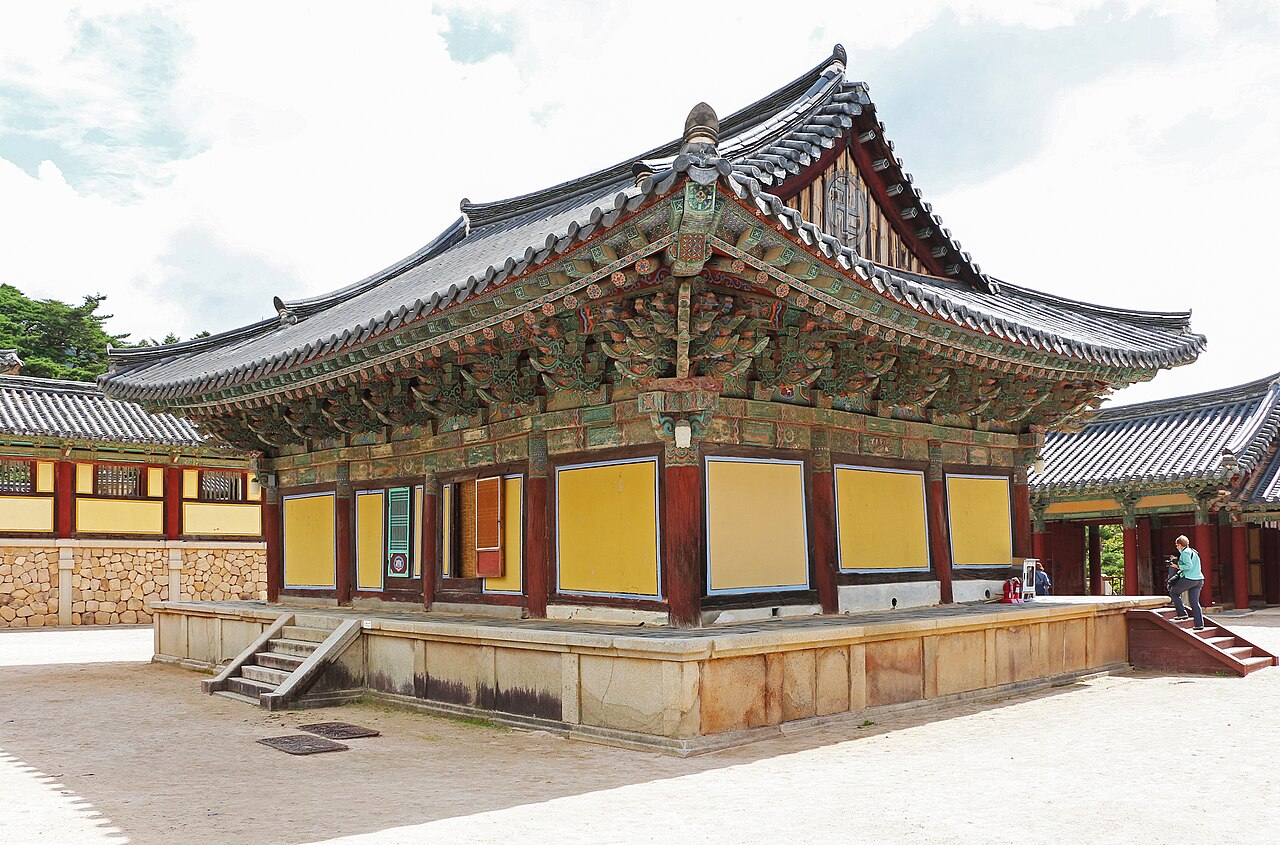
Bulguksa is celebrated for a balanced composition of wooden halls, terraces and ornamental stone structures that integrate with the hillside setting. Two stone pagodas at the site — the ornate Dabotap and the simpler Seokgatap — are among Korea’s best known pagodas. Other distinctive elements include paired arched bridges that form a ceremonial stairway, and finely cast gilt‑bronze images of the Buddha.
- Dabotap (national treasure no. 20): a highly detailed, elegant stone pagoda noted for its intricate carving and symbolic layers.
- Seokgatap (national treasure no. 21): a more austere, geometric pagoda that contrasts with Dabotap’s ornamentation.
- Cheongun‑gyo (Blue Cloud Bridge) and Baegun‑gyo (White Cloud Bridge) (national treasure no. 23): two paired bridges that form a ceremonial ascent toward the main compound.
- Two gilt‑bronze Buddha statues (national treasures nos. 26 and 27): exemplary examples of Korean metalwork used for devotion and ritual display.
Cultural importance and use
Bulguksa functions both as a living temple and as a cultural monument. It remains an active site for Buddhist practice while also serving as a focal point for scholarship, tourism and public appreciation of Korea’s religious art and architecture. The juxtaposition of ornate stone pagodas and simple wooden halls illustrates philosophical and aesthetic values in East Asian Buddhist architecture.
Conservation, interpretation and visiting
Conservation of Bulguksa balances building preservation with visitor access. Careful restoration work has emphasized traditional materials and techniques where possible, and interpretive efforts present the site’s history and symbolic program to the public. Visitors commonly study the contrast between Dabotap and Seokgatap, ascend the ceremonial bridges, and view the gilt statues inside the main halls; for contextual reading consult general resources on Korean Buddhism or guides to Gyeongju. For comparative study of iconography, see references on the historical image types of the Buddha.
Related articles
Author
AlegsaOnline.com Bulguksa: The Historic Buddhist Temple of Gyeongju Leandro Alegsa
URL: https://en.alegsaonline.com/art/15228
Sources
- english.visitkorea.or.kr : KOREA TOURISM ORGANIZATION
- whc.unesco.org : whc.unesco.org/en/list/736
- exploringkorea.com : National treasure of Korea