
The Conversation (1974 film)
1974 mystery-thriller by Francis Ford Coppola about surveillance, paranoia, and moral consequence, starring Gene Hackman. Acclaimed for sound design and preserved in the US National Film Registry.
The Conversation is a 1974 American mystery-thriller film written, produced and directed by Francis Ford Coppola. The picture centers on a surveillance expert whose routine wiretapping job escalates into a crisis of conscience when he begins to suspect the recorded subjects face mortal danger. The film is widely regarded for its spare storytelling, atmospheric sound design and exploration of privacy and isolation in urban life. Film classification and genre discussions often place it alongside psychological thrillers and modern noir; see also genre studies.
Image gallery
1 Image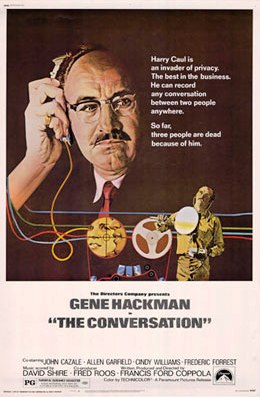
Cast and key contributors
- Gene Hackman stars as the central listener, Harry Caul.
- Supporting performers include John Cazale, Allen Garfield, Cindy Williams, Frederic Forrest, Harrison Ford, Teri Garr and Robert Duvall.
- Production is notable for Coppola's control over writing, producing and direction, and for innovative sound editing that foregrounds recorded audio as a dramatic element.
The plot is deliberately restrained: rather than rely on action set pieces, the narrative builds tension through close attention to surveillance technology, fragmented conversations and the protagonist's growing paranoia. The film examines ethical questions about observation, the reliability of recorded evidence and the distance between listener and subject. Critics and scholars often discuss its commentary on post‑1970s urban anonymity and the moral cost of detached professional competence.
Reception and legacy
Upon release the film received strong critical praise for performance, direction and sound work and earned three Academy Award nominations in 1974, including Best Picture. It competed in the same awards season as The Godfather Part II, another film associated with Coppola. Over time the movie's reputation has grown; it is frequently cited in studies of cinematic sound and surveillance narratives.
In 1995 the film was selected for preservation in the United States National Film Registry by the National Film Registry at the Library of Congress as "culturally, historically, or aesthetically significant." This recognition underscores the movie's continuing importance as an artistic work that captures anxieties about privacy and technology while showcasing meticulous filmmaking craft.
For viewers interested in themes of listening, ethics and modern solitude, The Conversation remains a compact, powerful study. Further reading and resources can be found through director and actor filmographies, sound design texts and retrospectives that analyze how the film's minimalist approach creates sustained suspense from a few recorded phrases and a mounting psychological unease.
Author
AlegsaOnline.com The Conversation (1974 film) Leandro Alegsa
URL: https://en.alegsaonline.com/art/146586