
Phillip Parker King: Australian-born Royal Navy hydrographer and colonial statesman
Biography of Phillip Parker King (1791–1856), an Australian-born Royal Navy officer and explorer who surveyed coasts, served in New South Wales government, and left a legacy of charts and place names.
Phillip Parker King (13 December 1791 – 26 February 1856) was an Australian-born officer of the Royal Navy, a skilled hydrographic surveyor and a colonial politician. Born on Norfolk Island, he became noted for conducting careful surveys of the Australian coastline and took part in surveys of South American shores. His work produced charts and observations that improved navigation and informed later exploration and settlement in the region.
Image gallery
4 Images


Early life and family background
King was the son of Philip Gidley King and Anna Josepha (née Coombe). His given names commemorate Arthur Phillip, the first governor of the colony for which his father served as an early administrator; the different spellings of "Philip" and "Phillip" reflect family naming traditions. He grew up within the networks of the colonial administration in the territory that became the colony of New South Wales. In 1817 he married Harriet Lethbridge and the couple raised eight children. Two of his sons pursued careers as pastoralists and entered colonial politics, following the family’s public-service traditions.
Naval career and surveying work
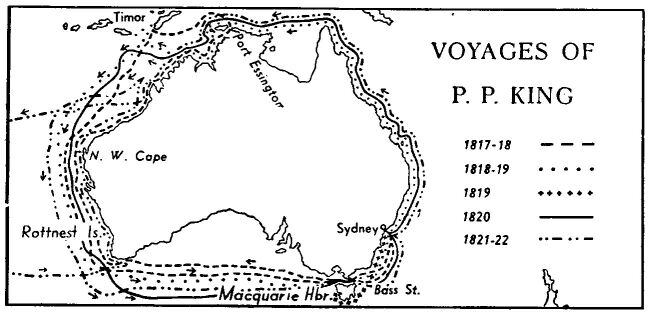
King served as a naval officer and devoted much of his professional life to hydrographic surveying. Working in the waters around Australia, he carried out methodical coastal examinations that filled large gaps in contemporary charts. His surveys combined soundings, coastal profiles and written remarks on harbours and shoals, and were valued by mariners and by later scientific expeditions. He also participated in surveys of Patagonian coasts in South America, contributing to the broader nineteenth‑century effort to chart remote shores.
Public roles, honours and later years
Beyond exploration, King took part in colonial public life. He served as a member of the New South Wales Legislative Council, where his experience with maritime matters and colonial administration informed debates about ports, navigation and settlement. He was elected a fellow of the Royal Society, a recognition of his scientific contributions, and in 1855 he was promoted on the retired list to the rank of rear admiral. He died in North Sydney in February 1856.
Legacy and commemorations
King’s name appears across maps and in natural history. Geographic features, islands and waterways were named in his honour as British and colonial surveyors and mapmakers adopted names to reflect contributions to charting and exploration. One notable example is King Sound in the Kimberley region of Western Australia. His interest in natural history and his contacts with collectors and scientists helped ensure his name became attached to species described by later taxonomists.
- Reptile species named after King include several well‑known taxa such as Chlamydosaurus kingii and Egernia kingii, among others.
- He is credited with producing practical charts that improved safety for ships visiting the coasts of the colony and neighbouring waters.
Notable facts and distinctions
King combined roles that were common for educated naval officers of his era: sailor, surveyor, naturalist correspondent and colonial official. His origins on Norfolk Island and his family connection to early colonial governors situate him within the formative generation of European settlement in the region. Researchers and local histories continue to cite his charts and journals when retracing early nineteenth‑century voyages or studying the genesis of coastal place names.
For further biographical and historical material, consult institutional resources and digitised collections that preserve his charts, journals and official reports. These primary documents illuminate both the practical methods of early hydrography and the wider context of exploration, science and colonial governance in which Phillip Parker King operated.
Related topics and resources: Australian coastline, Patagonian coasts, colonial New South Wales history (Sydney), family genealogy (Philip Gidley King), and the life and service of Governor Arthur Phillip. Additional institutional and regional records can be found through maritime and state archives (Royal Navy records, New South Wales repositories, and regional catalogues such as those for Norfolk Island and Western Australia).
Author
AlegsaOnline.com Phillip Parker King: Australian-born Royal Navy hydrographer and colonial statesman Leandro Alegsa
URL: https://en.alegsaonline.com/art/144173