
Death and state funeral of Richard Nixon
Overview of Richard Nixon's April 1994 death, the subsequent state funeral at his presidential library in Yorba Linda, and the ceremonies, attendees, and historical context.
Overview
Richard Milhous Nixon, the 37th President of the United States, died on April 22, 1994 at age 81 after suffering a stroke four days earlier. His passing marked the first death of a former U.S. president in 21 years. The event reopened public attention on a complex public life that included both high-level diplomacy and the scandal of Watergate.
Nixon's name and office are widely recognized: Richard Milhous Nixon served as the 37th President from 1969 to 1974. The immediate cause of his death was complications following a stroke, and the nation observed a series of memorial events culminating in a state funeral held several days later.
Image gallery
3 Images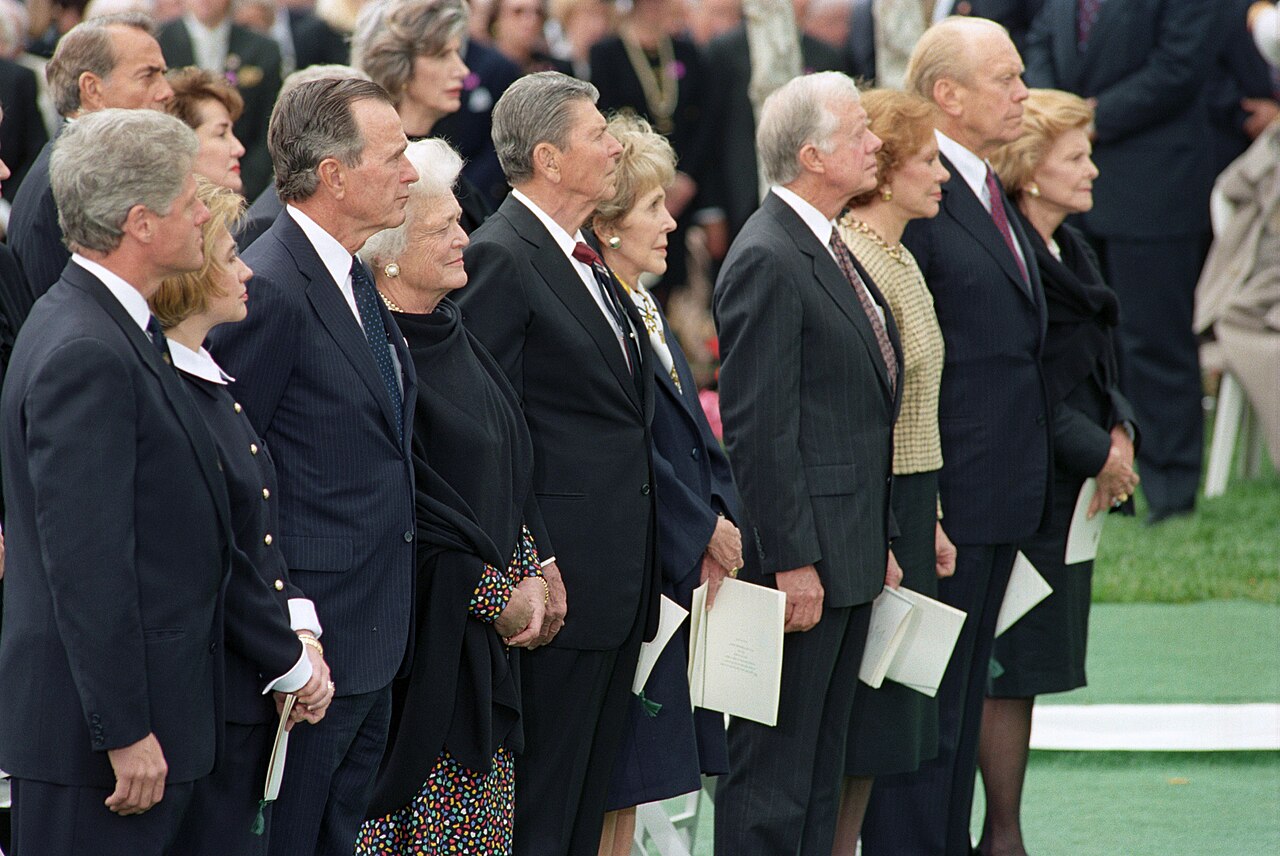


Ceremony and public events
The formal state funeral took place five days after his death at the Richard Nixon Presidential Library and Museum in his hometown of Yorba Linda, California. State funerals for U.S. presidents typically combine public memorial services with military honors; Nixon's observances included both public and private elements to serve family, former colleagues, and the broader public.
- Public memorial service at the presidential library
- Military honors and ceremonial components
- Attendance by senior political figures and international representatives
- Final interment at the library's grounds
As with other presidential funerals, leaders from around the United States and abroad came to pay respects. The ceremonies were intended to balance ritual protocol, the wishes of Nixon's family, and the historical controversy surrounding his presidency.
His death was the first presidential death since that of Lyndon B. Johnson in 1973, a reminder of the finite arc of political leadership and the periodic national process of mourning and historical reassessment. The funeral and associated events offered a public moment to reflect on Nixon's achievements in foreign policy, his resignation amid Watergate, and the longer-term debates over his legacy.
Today the Richard Nixon Presidential Library and Museum remains the principal commemorative site for his life and career. The library hosts archival material, exhibits, and the gravesite, and it continues to be a focal point for scholarship and public visits concerning Nixon's role in 20th-century American politics.
Richard Milhous Nixon, the 37th President, left a contested but enduring imprint on U.S. history; his death and state funeral in 1994 were both an end point and a prompt for renewed historical discussion.
Author
AlegsaOnline.com Death and state funeral of Richard Nixon Leandro Alegsa
URL: https://en.alegsaonline.com/art/137348