
Brake van
A small railway vehicle carrying a hand-operated brake and accommodation for a guard; used historically to assist braking, signal and protect the rear of freight trains, now mostly preserved on heritage lines.
A brake van is a small railway vehicle equipped with a hand-operated brake and space for a train guard. Historically fitted to the end of freight trains, its primary purposes were to provide additional braking force, to serve as a lookout and signalling post for the crew, and to display the train's tail lamp. Brake vans are most commonly associated with the United Kingdom and Australia but have equivalents or analogous vehicles in other countries.
Image gallery
7 Images


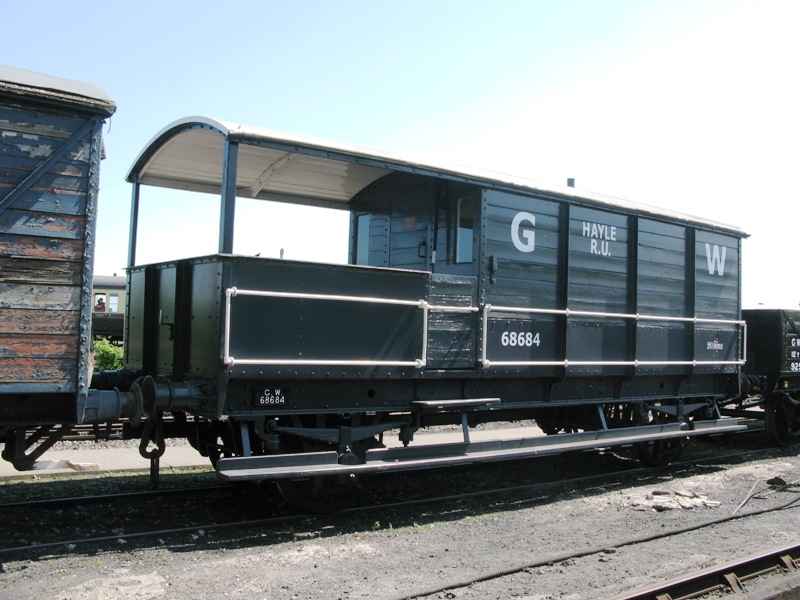
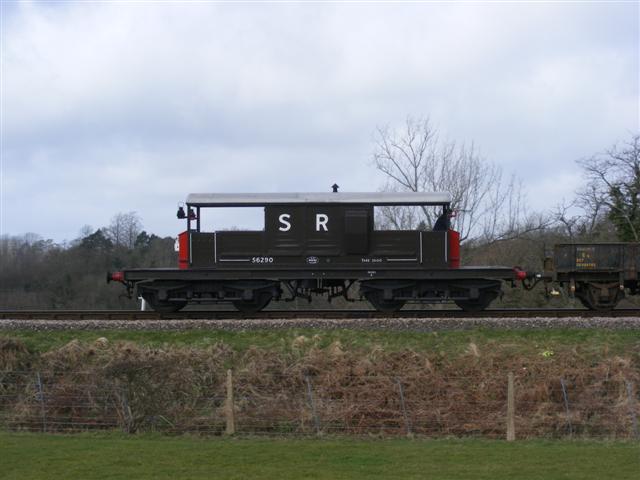
Design and main features
Typical brake vans are compact, often mounted on a single four-wheeled underframe rather than bogies. Common features include:
- Hand brake: a wheel or lever that the guard could apply to hold or slow the train when continuous brakes were absent or to supplement them.
- Guard's accommodation: simple shelter with windows for observing the train, space for paperwork and lamps, and sometimes heating by a small stove.
- Tail signalling: a fixed or hand-operated lamp to mark the end of the train and show its status to other trains and signalmen.
History and development
Brake vans emerged in the 19th century as railways expanded and mixed consists of wagons without continuous brakes became common. On unfitted freight trains, the guard's van provided the only convenient means to apply brakes at the rear and to warn following trains of problems. Over time, the spread of continuous braking systems — vacuum or air brakes — and improved operational rules reduced the need for a dedicated brake van on many services.
Operational role and examples
In operation, a guard could apply the brake to stabilise a stopped train, assist braking on long downgrades, or keep the rear portion secure during shunting. Brake vans also functioned as a base for signalling with flags or lamps. Today they survive mainly on heritage railways, where they are restored and used for authentic demonstration trains and for the guard's duties in preservation settings.
Regional names and distinctions
Terminology varies by region. In the UK and Australia the term brake van or guard's van is common. The North American counterpart is the caboose, but cabooses typically differ in appearance and construction, often riding on bogies rather than a simple four-wheeled chassis; see also discussions of bogie-equipped cars at related resources. More generally, a brake van is a type of railway vehicle used to support train braking and crew functions.
Notable fact: while the brake van's operational necessity declined with modern braking systems, it remains an important icon of freight railway history and is frequently preserved for education and demonstration.
Related articles
Author
AlegsaOnline.com Brake van Leandro Alegsa
URL: https://en.alegsaonline.com/art/13675