
Berimbau: Brazilian single‑string musical bow central to capoeira
The berimbau is a single‑string musical bow of African origin, central to capoeira. It consists of a wooden bow, wire string and gourd resonator, and directs rhythm, tempo and style in the roda.
Overview
The berimbau is a single‑string percussion instrument often described as a musical bow. It is most closely associated with Afro‑Brazilian culture and the martial art‑dance of capoeira, where the berimbau sets tempo, indicates game style and signals changes during the roda. Although now emblematic of Brazil, the instrument has roots in West and Central African bow‑instruments that accompanied song, dance and ritual.
Image gallery
6 Images



Construction and main parts
A typical berimbau has a flexible wooden rod (verga), a steel string or wire (arame) stretched from end to end, and a hollow gourd resonator (cabaça) attached near the lower half. The player holds a thin wooden stick (baqueta) to strike the string and uses a small stone, coin or pressed metal (dobrão) to modulate pitch and timbre. A basket shaker (caxixi) is sometimes played in the same hand to add rhythmic texture.
Sound and technique
Sound is produced by striking the string with the baqueta while changing contact between the dobrão and the string to alter pitch and create buzzing or muted tones. Moving the gourd closer to or farther from the stomach modifies resonance. Players combine right‑ and left‑hand motions to produce alternating patterns; a single berimbau can produce several distinct sounds that together suggest melody and rhythm.
Role in capoeira and musical contexts
In a capoeira roda the berimbau leads the ensemble: its rhythm determines the speed and character of the game and calls particular styles or movements. Several named rhythmic patterns, or toques, are associated with different approaches to the game, from slow, strategic Angola styles to faster, more acrobatic patterns. Beyond capoeira the berimbau appears in Brazilian folk and popular music and as a cultural symbol in performances and education.
History and cultural significance
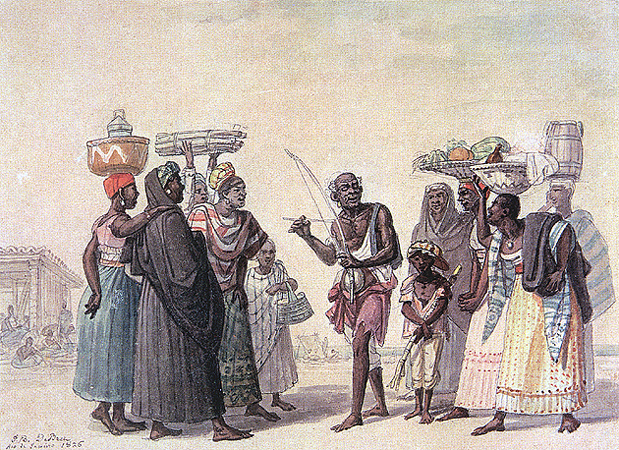
Derived from African musical bows brought by enslaved peoples, the berimbau evolved in Brazil into a distinctive instrument tied to Afro‑Brazilian identity and resistance. It remains a living tradition taught in capoeira schools and community groups, and it continues to inspire musicians and scholars exploring diasporic musical connections between Africa and Brazil. For further practical and historical details see resources on the instrument and its repertoire (musical bow studies).
- Key parts: verga, arame, cabaça, dobrão, baqueta, caxixi
- Common types: gunga (low), médio (middle), viola (high)
- Main functions: rhythm leader, tempo control, stylistic cueing
Questions and answers
Q: What is a berimbau?
A: A berimbau is a single-string percussion instrument, a musical bow, from Brazil.
Q: Where did the berimbau originally come from?
A: The berimbau originally came from Africa where it receives different names.
Q: What is the berimbau used for in capoeira?
A: In capoeira, the berimbau leads the capoeiristas movement in the roda.
Q: What is capoeira?
A: Capoeira is an Afro-Brazilian martial art.
Q: What role does the berimbau play in capoeira games?
A: The faster the berimbau is playing the faster the capoeirista moves in the game.
Q: What is the pronunciation of berimbau in Portuguese?
A: The pronunciation of berimbau in Portuguese is [beɾĩˈbaw].
Q: How did the berimbau come to be used in capoeira?
A: The berimbau was eventually brought into the practice of the Afro-Brazilian martial art capoeira.
Author
AlegsaOnline.com Berimbau: Brazilian single‑string musical bow central to capoeira Leandro Alegsa
URL: https://en.alegsaonline.com/art/135228