
486958 Arrokoth
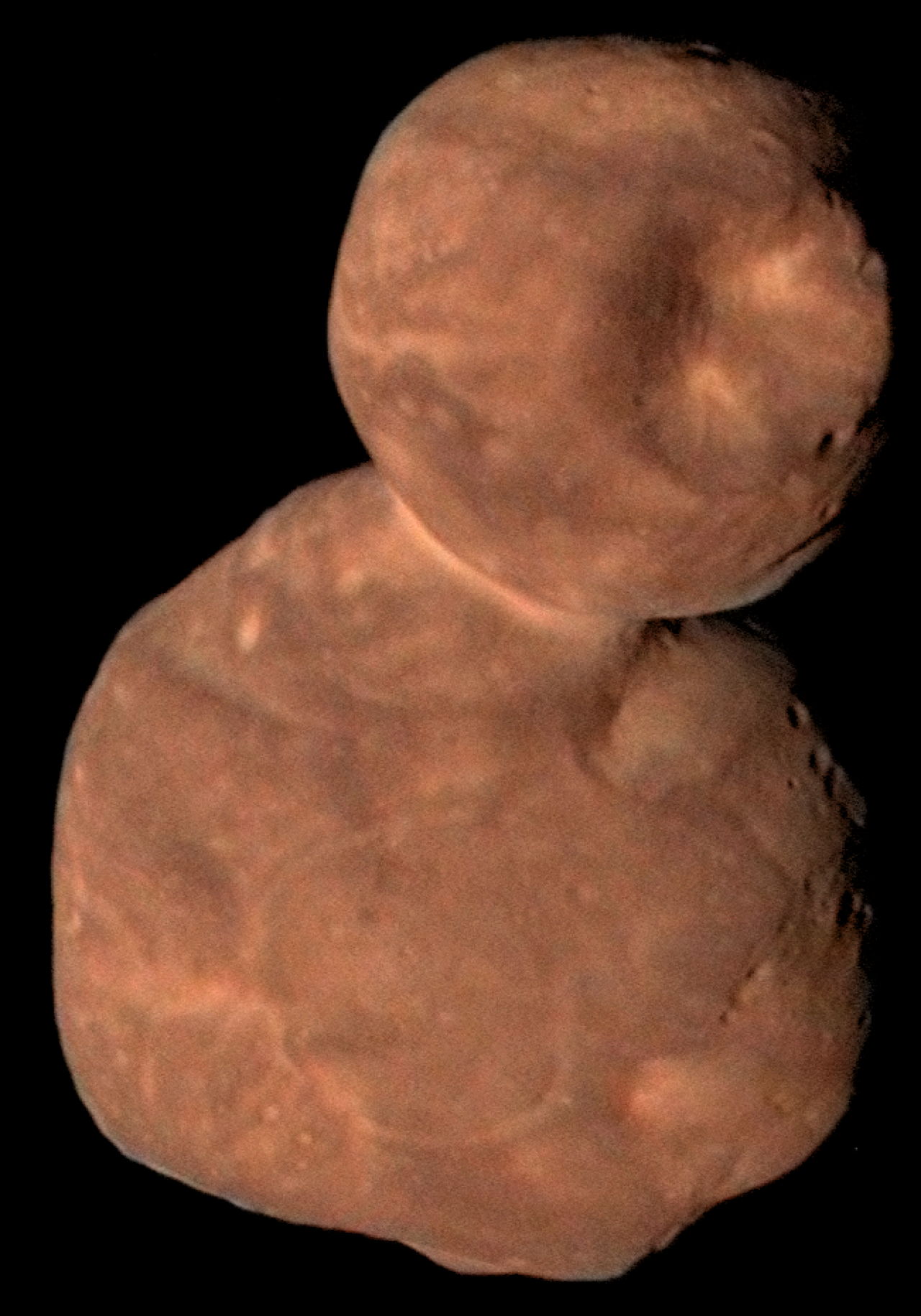
486958 Arrokoth is a bilobed Kuiper belt object visited by New Horizons in 2019. A contact binary of two primordial planetesimals, its shape, surface, and composition illuminate early solar system formation.
486958 Arrokoth (provisional designation 2014 MU69) is a small trans-Neptunian body in the outer Solar System that was the target of NASA's New Horizons spacecraft after its Pluto flyby. Classified as a trans-Neptunian object and a member of the cold classical population of the Kuiper belt, Arrokoth provided the first close-up look at a very small, ancient planetesimal beyond Neptune.
Image gallery
10 Images





Physical characteristics
Arrokoth is a contact binary formed from two lobes joined at a narrow neck. The combined object measures roughly 36 km across, with the larger lobe about 21 km and the smaller about 15 km in diameter. High-resolution images revealed a smoothly rounded, gently merged shape with few large impact scars, a surface tinged reddish by complex organic compounds called tholins, and textural variations that suggest a mix of ices and rock. Observations indicate a slow rotation and a relatively low-energy contact between the lobes, implying a gentle accumulation rather than a violent collision.
Discovery, mission encounter, and name
Arrokoth was discovered in 2014 during a search for a post-Pluto New Horizons target and was designated 2014 MU69 until it received minor planet number 486958. New Horizons flew past Arrokoth on 1 January 2019, returning imagery and data that transformed understanding of small-body formation. The team initially nicknamed the object "Ultima Thule"; pronunciations varied and the informal name generated controversy because of cultural connotations. Later in 2019 the object was officially named "Arrokoth," a word from the Powhatan/Algonquian language meaning "sky" or "clouds." The informal lobes are still sometimes referred to as "Ultima" and "Thule," with several pronunciations recorded.
Origin and scientific importance
Scientists interpret Arrokoth as a primordial relic preserved since the era of planet formation. Its bilobed form and delicate surface suggest it formed by gradual accretion of small bodies in a dynamically cold region of the Kuiper belt. Because it appears relatively unaltered by subsequent collisions or thermal processing, Arrokoth offers direct evidence about how planetesimals—building blocks of planets—assembled in the early Solar System. The composition, color, and morphology have been used to refine models of outer‑solar-system chemistry and accretion.
Key facts
- Provisional designation: 2014 MU69; permanent number: 486958.
- Type: contact binary in the Kuiper belt, member of the cold classical population.
- Approximate size: total length ~36 km; lobes ~21 km and ~15 km.
- Surface: reddish tholins over a mixture of ices and primitive materials.
Further analysis of New Horizons data and ongoing observations continue to refine Arrokoth's properties and its implications for planetary science. For introductions to related object classes and formation theories see resources on Kuiper belt, trans-Neptunian objects, and the broader concept of planetesimals.
Author
AlegsaOnline.com 486958 Arrokoth Leandro Alegsa
URL: https://en.alegsaonline.com/art/133916