
...And Justice for All (album)
Metallica's fourth studio album, released in 1988. Noted for long, complex songs, a stark production style that downplayed bass, and the breakthrough single "One."
Overview
Metallica's fourth full-length studio release, ...And Justice for All, reached audiences in late summer when it was issued on August 25, 1988. The record followed a traumatic year for the band and signalled a shift toward longer, more intricate compositions and lyrics that examine themes of corruption, punishment and legal or moral injustice.
Image gallery
4 Images


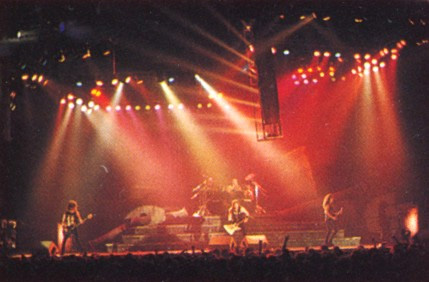
Recording, lineup and production
The album was Metallica's first studio record after the death of bassist Cliff Burton in 1986. He was succeeded by Jason Newsted, who joined for touring and the recording period. A short covers collection, The $5.98 E.P.: Garage Days Re-Revisited, was released in the interim but is often treated separately from the band's numbered albums. During production the band and producers adopted a dry, clinical mix that many listeners noticed for its almost inaudible bass part; that characteristic has become one of the album's most discussed technical features.
Music, structure and themes
Musically the album emphasizes extended arrangements, frequent tempo shifts and dense guitar work: songs are often longer than typical rock singles and include multiple movements that borrow from progressive and thrash-metal approaches. Lyrically the material addresses institutional failure, the cost of war, media manipulation and personal disillusionment, which together give the record a darker, more cerebral tone than some earlier releases.
Release, singles and reception
The lead single "One" became a prominent MTV video and helped the band reach a wider mainstream audience; it remains one of Metallica's best-known songs. Critics praised the compositional ambition and musicianship while many listeners and reviewers criticized the album's sparse low end and the production choices that left bass lines largely unheard. Commercially the record expanded Metallica's international profile and set the stage for subsequent large-scale touring.
Legacy and notable tracks
- "One" — breakthrough single with a dramatic video.
- "...And Justice for All" — title track expressing themes of legal and moral decay.
- "Blackened" — aggressive opener known for complex riffs and tempo changes.
- "Harvester of Sorrow" — heavy mid-tempo piece with bleak lyrics.
The album's title echoes the phrase "...and justice for all" from the Pledge of Allegiance, reinforcing the record's preoccupation with fairness, authority and social critique. Over time the record is frequently cited as a turning point for the band: it combined technical ambition and mainstream exposure while also provoking debate about sound engineering and band dynamics during a period of personal loss and transition.
Questions and answers
Q: What is Metallica's fourth album called?
A: Metallica's fourth album is called "...And Justice For All".
Q: When was "...And Justice For All" released?
A: "...And Justice For All" was released on August 25, 1988.
Q: Who replaced Cliff Burton as Metallica's bass player?
A: Jason Newsted replaced Cliff Burton as Metallica's bass player.
Q: When did Cliff Burton die?
A: Cliff Burton died prior to the release of "...And Justice For All".
Q: What is the name of Metallica's EP that is often not counted as a Metallica album?
A: The name of Metallica's EP that is often not counted as a Metallica album is "The $5.98 E.P.: Garage Days Re-Revisited".
Q: How many songs does "The $5.98 E.P.: Garage Days Re-Revisited" contain?
A: "The $5.98 E.P.: Garage Days Re-Revisited" contains only five songs covered by Metallica.
Q: What is the reason for "The $5.98 E.P.: Garage Days Re-Revisited" not to be considered as a Metallica album?
A: "The $5.98 E.P.: Garage Days Re-Revisited" is not considered as a Metallica album because it only contains five cover songs.
Author
AlegsaOnline.com ...And Justice for All (album) Leandro Alegsa
URL: https://en.alegsaonline.com/art/133383