
William John Macquorn Rankine: 19th-century Scottish engineer and thermodynamicist
Summary of W. J. M. Rankine (1820–1872): his life, work on thermodynamics, the Rankine scale and cycle, teaching, major manuals, and lasting influence on engineering practice.
Overview
William John Macquorn Rankine (born July 5, 1820, in Edinburgh — died December 24, 1872, in Glasgow) was a Scottish engineer and physicist whose work helped to bring a systematic, energy-based approach to engineering practice in the 19th century. He combined theoretical analysis with practical experience in steam engineering, structural mechanics and machine design. Rankine is best known for the absolute temperature scale that bears his name and for the idealized thermodynamic model known as the Rankine cycle, widely used in the study of steam power plants.
Image gallery
9 Images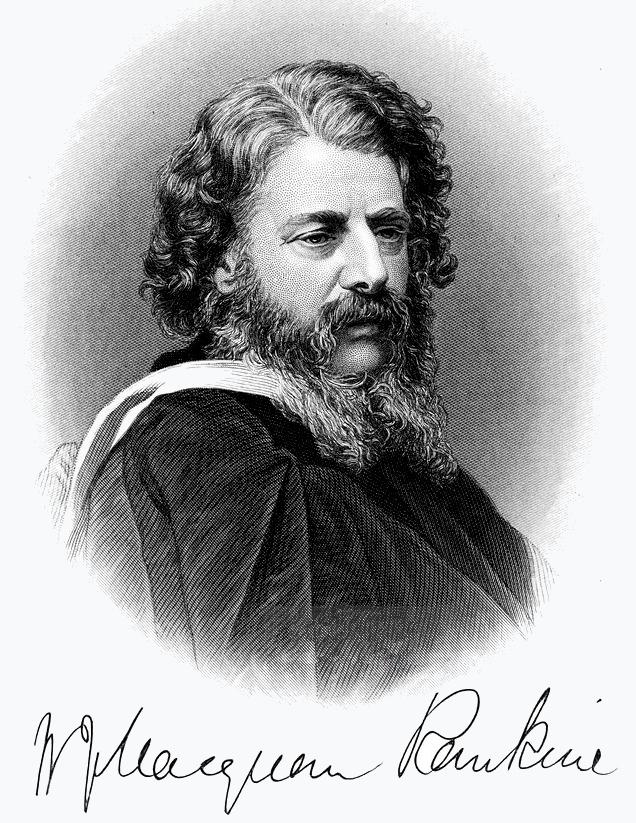


Major contributions and ideas
Rankine worked at the interface of applied mechanics and thermodynamics. He developed methods that related heat, work and internal energy in steam engines and other prime movers, and he gave careful treatments of stress, strain and the strength of materials that helped engineers translate theory into safe designs. His clear, methodical presentation of machine elements and structural problems made advanced topics accessible to practicing engineers.
Rankine scale and Rankine cycle
Rankine scale: an absolute-temperature scale using the Fahrenheit degree. It has been used in some branches of engineering calculations, especially in contexts where Fahrenheit units are customary (Rankine scale).
Rankine cycle: an idealized thermodynamic cycle that models the operation of steam engines and many thermal power stations. It provides a framework for comparing efficiencies and for understanding how components such as boilers, turbines and condensers interact in practice.
Publications and teaching
Rankine authored a series of influential manuals and textbooks that circulated widely in the latter half of the 19th century. These works treated the steam engine, applied mechanics and civil engineering in a way that blended rules of thumb, worked examples and rigorous analysis. His manuals, first appearing in the 1850s and continuing into the 1860s, became standard references for students and practitioners. He also held a university chair in engineering, where he influenced the development of engineering curricula and the professional training of engineers.
Approach and methods
Rankine emphasized physical reasoning and practical calculation. He presented problems so that engineers could follow a sequence from assumptions to numerical estimates, and he encouraged the use of energy concepts to judge machine behaviour. His work on materials and structures contributed to more systematic methods for assessing load-bearing capacity and stability in civil and mechanical designs.
Legacy and influence
Rankine belongs to a generation of engineers who bridged experimental science and industrial practice. His name remains attached to concepts taught in power engineering and thermodynamics courses, and his textbooks shaped engineering education for decades. For those seeking primary sources and more detailed biographies, consult specialized biographical entries and archives (biographical entry, archival resources, national biographical collections), standard histories of engineering (physics and engineering histories) and overviews of 19th-century thermodynamics (thermodynamics).
Further reading and resources
- Contemporary manuals and digitized editions: consult library catalogues and engineering archives (engineering archives).
- Introductory treatments of the Rankine cycle and comparisons with other cycles: see standard textbooks and course notes (Rankine scale and cycle notes).
- Historical studies of 19th-century engineering education and practice: consult academic reviews and curated collections (historical studies, period sources).
Rankine's combination of rigorous analysis and practical guidance helped to professionalize engineering and to shape how power systems and structures were taught and designed. Researchers and students wishing to explore his original writings will find editions and commentaries in national libraries and specialist repositories (1850s publications, biographical resources, archive catalogues).
Author
AlegsaOnline.com William John Macquorn Rankine: 19th-century Scottish engineer and thermodynamicist Leandro Alegsa
URL: https://en.alegsaonline.com/art/132944