
The 1860s: A Decade of War, Reform and Rapid Change
A concise overview of the 1860s covering major wars, state formation, industrial and scientific advances, cultural shifts, and the long-term impacts that shaped the later 19th century.
Overview
The 1860s were a transformative decade in which armed conflict, political reform and accelerating technology reshaped many parts of the globe. National boundaries and institutions were contested and remade while industrial expansion, new communications and scientific advances began to change economic and social life on a broad scale.
Image gallery
1 Image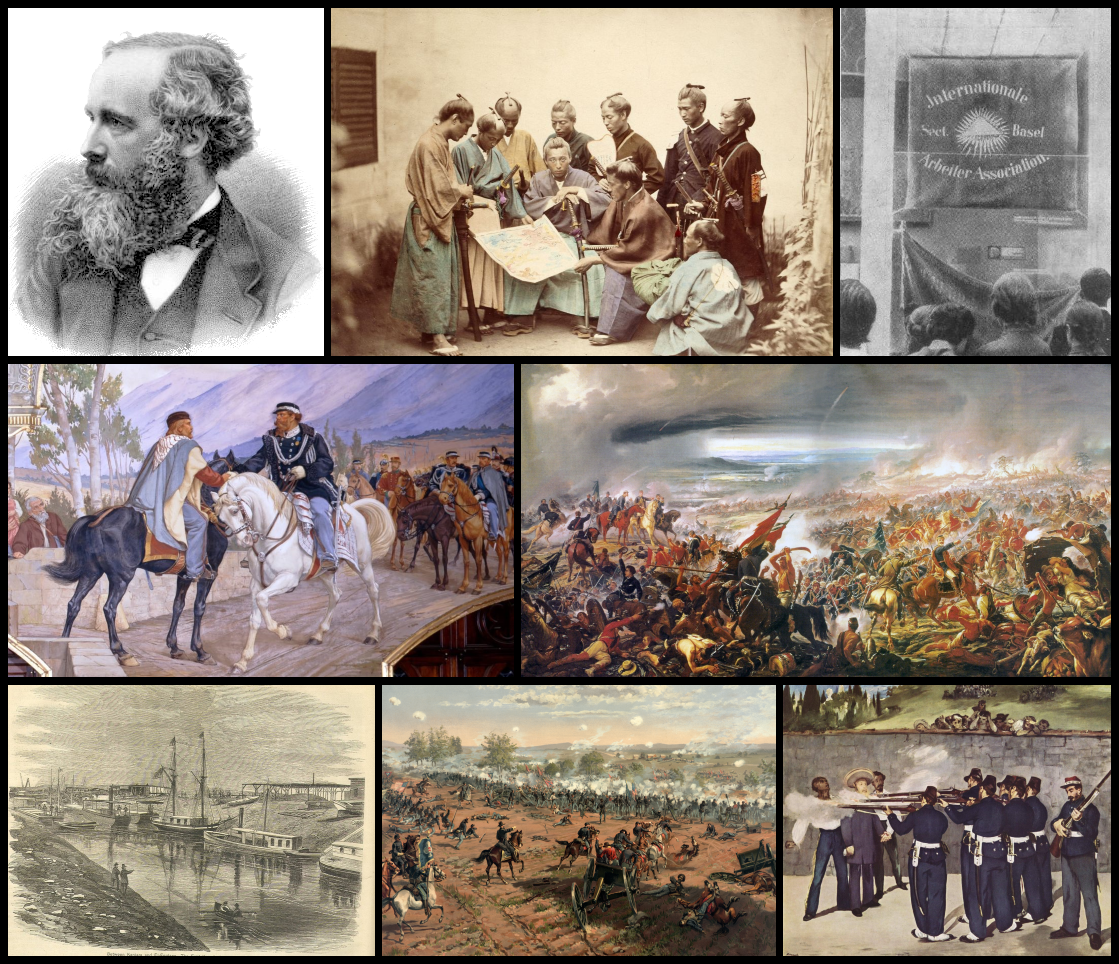
Major political and military developments
The American Civil War (1861–1865) was the century's defining conflict in North America: it preserved the United States as a single state and led to the legal abolition of slavery by the 13th Amendment. Reconstruction (beginning 1865) attempted to redefine citizenship, civil rights and political power in the postwar period. In Europe, Italian unification progressed with the proclamation of the Kingdom of Italy in 1861 and continued political consolidation thereafter. Prussia’s victory over Austria in the Austro-Prussian War of 1866 reorganized influence within German-speaking lands and set the stage for later unification.
Empire, rebellion and state formation elsewhere
Japan’s Meiji Restoration of 1868 ended Tokugawa rule and launched rapid modernization and centralization. Canada became a self-governing confederation in 1867. In Latin America, the War of the Triple Alliance (beginning 1864) and the end of the French intervention in Mexico (1861–1867) were major regional events. Large internal conflicts such as the Taiping Rebellion in China concluded during the decade, affecting population and rural economies.
Technology, industry and infrastructure
- Railroads and steamships expanded trade, migration and military logistics; the United States completed its transcontinental railroad in 1869 and the Suez Canal opened in 1869, shortening routes between Europe and Asia.
- Industrial manufacturing continued to spread and to adopt new materials and techniques. Telegraph networks and improvements in photography increased the speed and scope of information and news.
Science, medicine and culture
Scientific practice and public debates advanced: important work in chemistry and physics appeared in the decade, and medical research increasingly emphasized laboratory methods and germ-related approaches. Dmitri Mendeleev’s periodic ideas and advances in electromagnetic theory were part of a wider ferment. In the arts and letters, realism and early impressionist tendencies reflected urban life and social change; literature and visual arts began to respond to industrial society and modern warfare.
Social change and legacies
The 1860s raised lasting questions about citizenship, labor, and state authority. New political arrangements and technologies matured into the institutional foundations for the rapid economic growth and geopolitical tensions that would mark the late 19th century. The decade is widely seen as a hinge between older patterns of rule and the modernizing impulses that reshaped societies worldwide.
Related articles
Author
AlegsaOnline.com The 1860s: A Decade of War, Reform and Rapid Change Leandro Alegsa
URL: https://en.alegsaonline.com/art/111822