
Parmenides of Elea: life, central doctrines, and lasting influence
Parmenides, an early 5th century BC philosopher from Elea, argued that true reality is changeless Being. His poem and arguments shaped metaphysics, logic, and later philosophers such as Plato and the Eleatics.
Overview
Parmenides of Elea was an influential pre-Socratic thinker active in the early 5th century BC. Ancient sources identify him by his Greek name; see Πα��ρμενίδης ὁ Ἐλεάτης. He is remembered primarily as a philosopher who founded or inspired the Eleatic school of thought (Eleatic school). Only fragments of his single known work survive, but those fragments preserve an unusually systematic metaphysical argument that challenged ordinary assumptions about change, plurality and the reliability of sense perception.
Image gallery
10 Images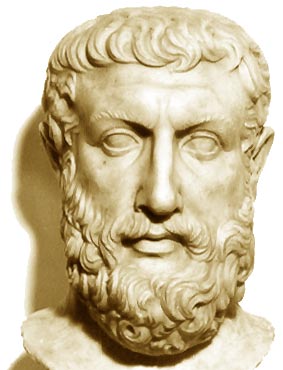


Central doctrines and arguments
Parmenides argued that what truly exists is a unified, unchanging Being. He drew a sharp distinction between two ways of understanding reality: a path of truth and a path of opinion. The path of truth lays out the consequences of accepting reasoned principles; the path of opinion describes the world as it appears to everyday sense experience. His basic conclusions have been summarized under the claim that change and non-being are impossible, and that being is whole, undivided and eternal. These themes are often summarized as the "two ways" or two views of reality presented in his poem.
Key features and representative arguments
- Being versus non-being: Parmenides maintained that it is impossible to think or speak of non-being; anything that can be meaningfully discussed must in some sense exist.
- Rejection of change: Because change would imply a transition between being and non-being, and non-being cannot be, genuine change is ruled out.
- Unity and immutability: True reality is a continuous, undifferentiated whole — not a composition of many independent things.
- Critique of the senses: Sense perception is treated as deceptive when it points to multiplicity and motion; reason is the privileged route to truth.
Work, structure and surviving material
Parmenides composed a didactic poem, sometimes titled "On Nature," written in hexameters. The poem is conventionally divided into a proem followed by the Way of Truth and the Way of Opinion. Only fragmentary lines and reports by later authors remain. Those fragments are dense and aphoristic, which has encouraged a wide range of scholarly reconstructions and debates about the precise logical form of his arguments.
Historical context and influence
Parmenides had a profound impact on subsequent Greek philosophy. The Eleatic position stimulated responses from thinkers such as Zeno (his followers used paradoxes to defend Parmenides' conclusions) and Melissus, and it posed central problems for Plato, who grapples with unity, change and the status of Forms in several dialogues — see Plato's engagement with Eleatic themes at Plato. Over time Parmenides' distinction between appearance and reason contributed to broader strands of metaphysical and logical inquiry that shaped later Western thought (Western philosophy).
Interpretations, disputes and legacy
Scholars disagree about how to label Parmenides' ontology. Some later readers have called his view a form of monism; others have emphasized the uniquely abstract, non-empirical character of his Being. It is best to avoid simplistic labels: while he argued for a single, unchanging reality, he did not supply a materialistic account in the way modern materialism is understood. His work remains important as an early example of reasoning from strict premises to radical metaphysical conclusions, and it continues to provoke discussion about the relations among thought, language and the appearances offered by the senses.
Why Parmenides still matters
Parmenides is studied not only for historical reasons but because his core challenge — whether change and plurality are ultimately real or illusory — remains central to metaphysics, philosophy of language and epistemology. His emphasis on the limits of sensory evidence and the demands of coherent reasoning provides a foundational contrast to philosophies that privilege empirical observation. For more introductory material and contextual readings, consult primary fragment collections and modern commentaries that trace his influence through the Eleatic school and into Plato and beyond.
Further reading and resources: Greek name and sources, Eleatic tradition, the two ways, Plato's responses, wider legacy, philosophical overview.
Author
AlegsaOnline.com Parmenides of Elea: life, central doctrines, and lasting influence Leandro Alegsa
URL: https://en.alegsaonline.com/art/128080