
Bolesław I the Brave (Bolesław I Chrobry)
Medieval Polish ruler (c.967–1025), duke (992–1025) and first crowned king (1025). Expanded Poland's territory, strengthened the church, and shaped relations with Germany, Bohemia and Kievan Rus'.
Bolesław I the Brave (Polish Bolesław I Chrobry; c. 967 – 17 June 1025) was a central figure in early Polish statehood. He succeeded his father Mieszko I as duke and ruled from 992 until his coronation as king on 18 April 1025. His reign marked a period of territorial expansion, ecclesiastical consolidation and active diplomacy in Central and Eastern Europe.
Image gallery
10 Images


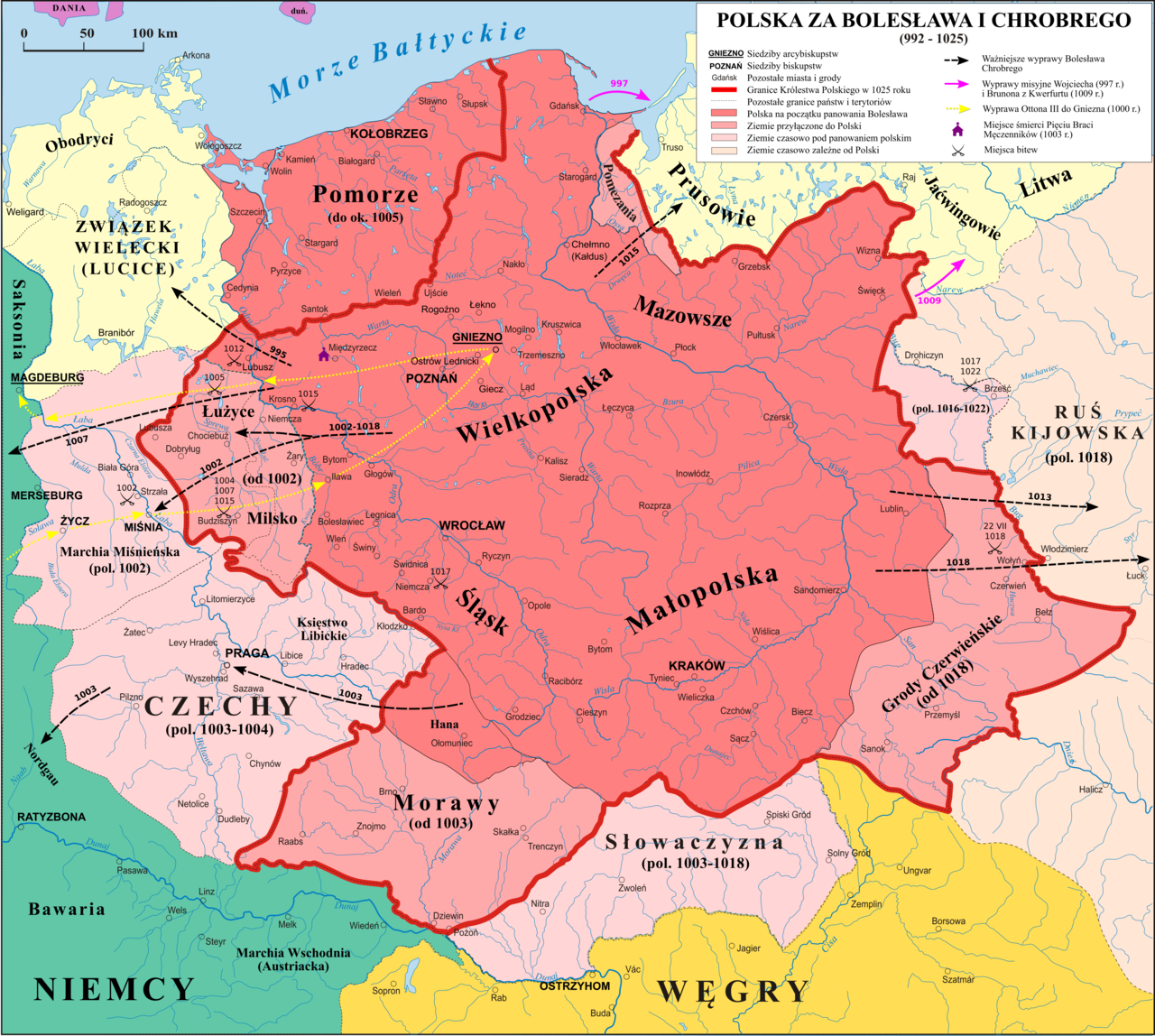


Early life and accession
Born into the Piast dynasty, Bolesław grew up during the conversion of Poland to Christianity and the formation of a territorial state under his father. He became the principal ruler after Mieszko's death and secured his position through alliances and internal reforms that strengthened central authority. Contemporary chronicles give him the byname "Chrobry", often translated as "the Brave" or "the Valiant".
Territorial expansion and military activity
Bolesław pursued an energetic policy of expansion and intervention. He briefly ruled Bohemia (1003–1004) during a period of instability there and fought a series of conflicts with the Holy Roman Empire. The long struggle with German rulers ended in the early 11th century with agreements that left Poland in control of western borderlands for a time. He also intervened in the dynastic struggles of Kievan Rus', mounting campaigns that led to temporary Polish influence in the region.
Church, administration and diplomacy
One of Bolesław's most enduring achievements was the strengthening of the Polish church. The Congress of Gniezno in 1000, where he hosted Emperor Otto III, led to the creation of an independent archbishopric at Gniezno and enhanced the ecclesiastical standing of his realm. Politically, he balanced relations with the papacy, the empire and neighboring principalities to secure recognition and support for Poland's growing autonomy.
Key events and succession
- c. 967: Birth into the Piast dynasty.
- 992: Becomes Duke of Poland.
- 1000: Congress of Gniezno and church reorganization.
- 1003–1004: Temporary rule in Bohemia.
- 1018: Notable campaigns in the east and territorial gains.
- 18 April 1025: Crowned king of Poland; dies 17 June 1025.
Legacy and significance
Bolesław I is remembered as a founder of the medieval Polish state who combined military ambition with institution-building. His short reign as crowned king symbolically affirmed Poland's royal status in the Christian West. He was succeeded by his son, Mieszko II, and later medieval chroniclers regarded Bolesław as one of Poland's most important early rulers. Modern historiography views him as pivotal in transforming a regional duchy into a kingdom with wider European ties.
Notable distinctions: his epithet "Chrobry"; the association with the Congress of Gniezno; and his role in shaping borders and church structures that influenced Poland's development through the Middle Ages.
Related articles
Author
AlegsaOnline.com Bolesław I the Brave (Bolesław I Chrobry) Leandro Alegsa
URL: https://en.alegsaonline.com/art/12762
Sources
- britannica.com : Boleslaw I of Poland, Encyclopaedia Britannica.