
Counties of South Carolina (List and Overview)
Complete overview and list of South Carolina's 46 counties, with origin, government roles, notable counties and cities, and distinctions among county administrations.
Overview
The U.S. state South Carolina is divided into 46 counties that serve as its primary local government subdivisions. Counties provide a range of services—law enforcement, courts, public records, road maintenance, and local administration—and act as the geographic framework for state programs and elections. South Carolina currently has a statutory limit of 46 counties; that number is the maximum allowed by state law (see legal note).
Image gallery
2 Images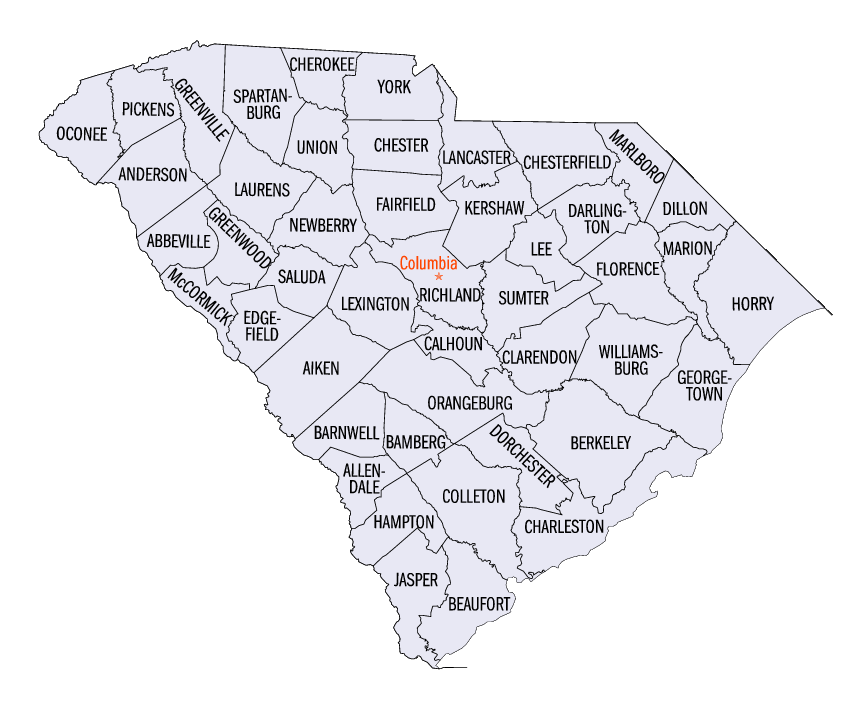

Origins and development
The county system in South Carolina evolved from the colonial-era parish and district structures. Over the 18th and 19th centuries, boundaries were adjusted and new counties created as populations shifted, transportation improved, and administrative needs changed. The modern pattern of 46 counties reflects historical settlement, economic centers, and later legal decisions that set the ceiling on the number of counties.
Government, functions and variations
Counties in South Carolina administer a mixture of services: they maintain property and vital records, run county courts and jails, oversee local roads outside municipalities, and provide social and public health services in some areas. Structures vary: many counties are governed by an elected county council or commission, often led by a chair, and elected officials such as sheriffs and clerks manage specific functions. Some services are consolidated with cities or regional agencies in more urbanized counties.
Notable counties and cities
Certain counties are widely recognized because they contain major cities or economic centers. For example, Richland County includes Columbia, the state capital; Charleston County contains the historic port city of Charleston; Greenville and Horry counties are known respectively for their urban centers and coastal resort areas such as Myrtle Beach. These counties illustrate the variety of urban, suburban, and rural character found across the state.
Complete list of counties
- Abbeville
- Aiken
- Allendale
- Anderson
- Bamberg
- Barnwell
- Beaufort
- Berkeley
- Calhoun
- Charleston
- Cherokee
- Chester
- Chesterfield
- Clarendon
- Colleton
- Darlington
- Dillon
- Dorchester
- Edgefield
- Fairfield
- Florence
- Georgetown
- Greenville
- Greenwood
- Hampton
- Horry
- Jasper
- Kershaw
- Lancaster
- Laurens
- Lee
- Lexington
- McCormick
- Marion
- Marlboro
- Newberry
- Oconee
- Orangeburg
- Pickens
- Richland
- Saluda
- Spartanburg
- Sumter
- Union
- Williamsburg
- York
Distinctions and reference
While all counties share core responsibilities, they differ in population, area, economic profile and how services are delivered. Urban counties often collaborate with multiple municipalities, while rural counties may rely more heavily on county government for services. For summaries, maps and legal context about county boundaries and the statutory county limit, consult official state resources or county government websites about South Carolina counties.
Related articles
Author
AlegsaOnline.com Counties of South Carolina (List and Overview) Leandro Alegsa
URL: https://en.alegsaonline.com/art/124631
Sources
- scstatehouse.gov : Section 3, Article VIII of the South Carolina Constitution
- archives.sc.gov : South Carolina Department of Archives and History maps
- epa.gov : "EPA County FIPS Code Listing"
- naco.org : "NACo - Find a county"