
Blowback (firearm operating system)
Blowback is a self-loading firearm operating principle in which the cartridge case is driven rearward by gas pressure to cycle the action; used widely in pistols and submachine guns with several delayed variants.
Blowback describes a family of firearm operating systems that derive the energy to cycle the action from the rearward movement of the cartridge case after firing. When the propellant burns, gas pressure acts on the base of the cartridge case and tends to push it—and with it the breechplug, bolt, or slide—rearward. In pure blowback designs the breech is not mechanically locked to the barrel at the moment of ignition; instead, the mass of the bolt or slide and the strength of the return spring delay opening until pressures have dropped to a safe level.
Image gallery
10 Images


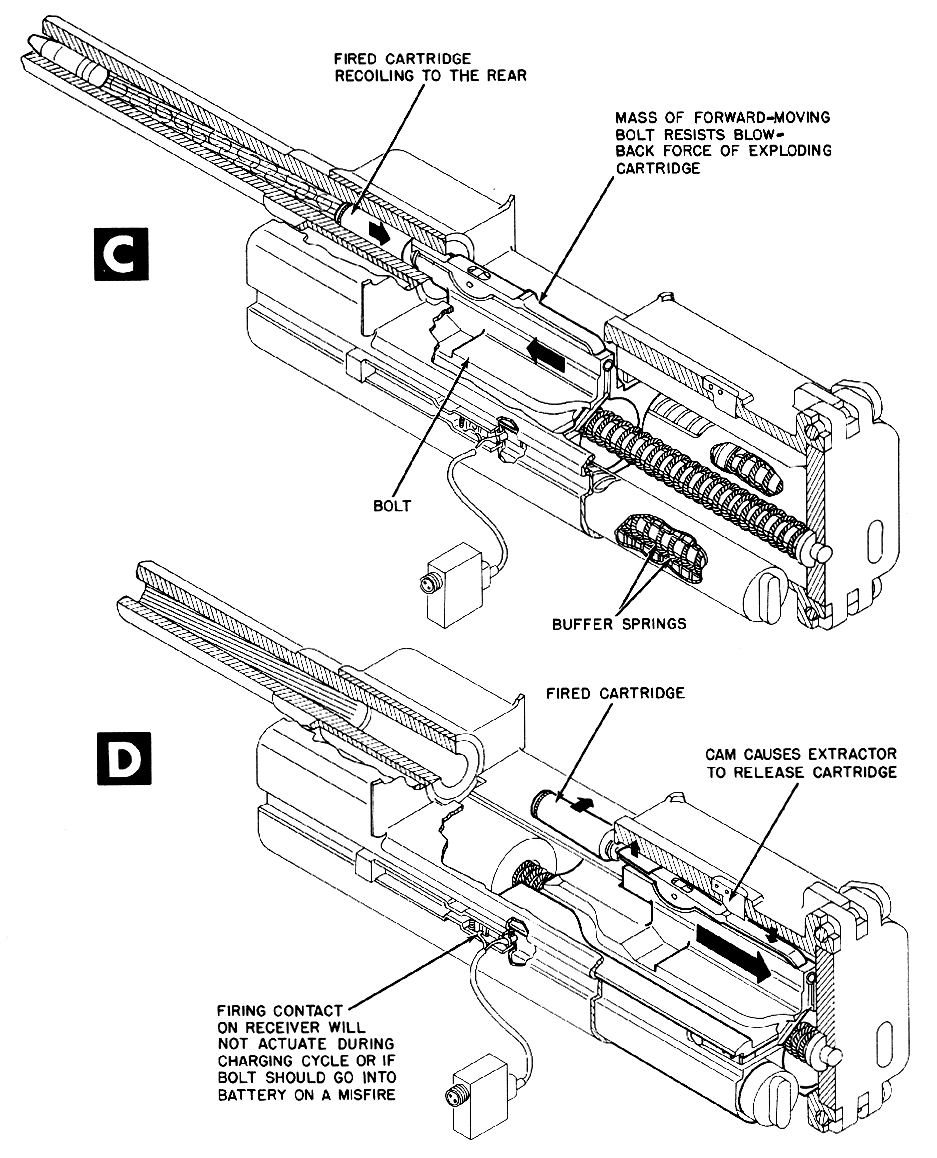


Basic principle and components
In simplest terms a blowback mechanism consists of a chambered cartridge, a movable breech element (bolt, slide, or breechblock), and a return spring. On discharge the case acts like a short piston pushed rearward by high-pressure gases. The inertia of the moving parts and the spring resistance must be sufficient to prevent premature opening, which could allow hot gas and unburned powder to escape before the bullet leaves the barrel. Extraction and ejection occur as the action moves rearward, followed by spring-driven forward movement that chambers the next round.
Variants and delay methods
Several distinct subclasses of blowback exist, differing by how they slow the opening of the breech:
- Simple (straight) blowback: The most basic type; common in low-pressure cartridges (.22 rimfire, .32 ACP, .380 ACP) and many open-bolt submachine guns. It relies solely on bolt mass and spring force.
- Delayed blowback: Uses mechanical disadvantages or gas pressure to retard bolt opening without a full locking mechanism. Common implementations include roller-delayed (used in some well-known rifles and submachine guns), lever-delayed, and gas-delayed systems.
- Primer-actuated and other experiments: A few less common designs use the primer's movement or other features to effect timing; these are comparatively rare and were mainly experimental or niche.
Applications and typical examples
Blowback is popular where simplicity, low cost, and compactness are priorities. It is widely used in small-caliber semi-automatic pistols and many historical and contemporary submachine guns. Open-bolt blowback actions have been favored in some wartime SMGs for ease of manufacture and cooling, while delayed blowback allows designers to use more powerful cartridges without very heavy bolts.
Advantages, limitations, and distinctions
Advantages of blowback systems include mechanical simplicity, fewer moving parts, and straightforward maintenance. Limitations arise with high-pressure rifle cartridges: safe operation would require impractically heavy bolts or very stiff springs unless a delay mechanism is introduced. Compared with gas-operated or locked-breech recoil systems, blowback designs can produce sharper felt recoil for a given cartridge and (in open-bolt designs) reduced first-shot accuracy or risk of cook-off in sustained fire.
Historical and technical notes
Blowback predates many complex locking arrangements and remains an important operating principle. The cartridge case functioning as a short, self-contained piston is a useful conceptual way to relate blowback to gas-operated systems—both use propellant gases to move parts—but blowback stops short of mechanically locking the breech. Over the 20th century designers developed delayed blowback variants to expand the range of usable cartridges, keeping the advantages of simpler actions while addressing the physical limits of straight blowback.
Questions and answers
Q: What is blowback?
A: Blowback is a system of operation for self-loading firearms that utilizes the energy from the motion of the cartridge case to push the breech open and eject spent cartridges.
Q: How does blowback obtain energy for operation?
A: Blowback obtains energy from the expanding gases created by the ignition of the propellant charge, which pushes the cartridge case to the rear, providing energy to operate the firearm.
Q: Are there different types of blowback systems?
A: Yes, there are different blowback systems that exist within this broad principle of operation, each distinguished by the methods used to control bolt movement.
Q: Is the breech locked at the time of firing in most actions that use the blowback operation?
A: No, in most actions that use blowback, the breech is not locked mechanically at the time of firing, but the inertia of the bolt and recoil spring(s) delays opening the breech until the bullet has left the barrel.
Q: Are there other operating principles for self-loading firearms besides blowback?
A: Yes, there are several other operating principles for self-loading firearms, including blow forward, gas operation, recoil operation, revolver, Gatling, and chain.
Q: Can locked breech designs use a form of blowback to perform the unlocking function?
A: Yes, some locked breech designs use a form of blowback, such as primer actuation, to perform the unlocking function.
Q: How does the cartridge case behave in the blowback principle?
A: The cartridge case behaves like a piston driven by the powder gases in the blowback principle, which is considered a simplified form of gas operation.
Related articles
Author
AlegsaOnline.com Blowback (firearm operating system) Leandro Alegsa
URL: https://en.alegsaonline.com/art/12312
Sources
- google.com : Primer actuated M16 bolt
- orions-hammer.com : orions-hammer.com