
Joseph Erlanger
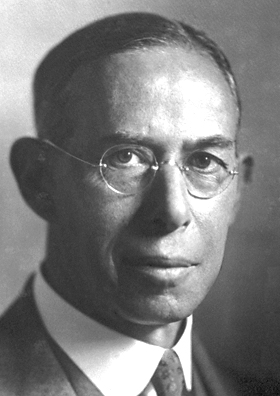
American physiologist Joseph Erlanger (1874–1965) shared the 1944 Nobel Prize with Herbert S. Gasser for showing that different nerve fibers have distinct conduction properties and functions.
Joseph Erlanger (5 January 1874 – 5 December 1965) was an American physician and physiologist whose experimental work transformed understanding of how nerves convey signals. He is best known for the Nobel Prize in Physiology or Medicine awarded in 1944, shared with Herbert Spencer Gasser, for demonstrating that nerve fibers differ in conduction velocity and functional role.
Image gallery
3 Images

Key contributions
Erlanger and his collaborators developed sensitive recording techniques to measure electrical activity in single nerve fibers. Using oscilloscopes and amplifiers, they showed that fibers vary by diameter, myelination and conduction speed. Their work provided a physiological basis for distinguishing fast, myelinated fibers (responsible for touch and motor signals) from slower or unmyelinated fibers (often associated with pain and temperature).
Career and methods
Trained as a physician and active in academic medicine, Erlanger spent much of his career on the faculty at Washington University in St. Louis, where he worked closely with Herbert S. Gasser. The pair refined instrumentation and recording approaches that allowed the first clear separation of compound nerve action potentials into contributions from different fiber groups.
Importance and applications
The classification of nerve fibers and the demonstration that distinct fibers carry different modalities had broad effects on neurology, anesthesiology and neuroscience. Clinical understanding of neuropathies, pain mechanisms and reflex pathways was advanced by their findings, and electrophysiological recording became a standard tool in both research and medicine.
Notable facts
- Shared the 1944 Nobel Prize in Physiology or Medicine with Herbert S. Gasser.
- Helped establish the physiological distinction between myelinated and unmyelinated fibers and the A–B–C grouping used in neurophysiology.
- His experimental approach emphasized precise electrical measurement and instrumentation innovation.
- Of Jewish descent, he remained an influential figure in American medical science through mid-20th century.
Erlanger's combination of careful measurement, inventive use of technology and clear physiological interpretation made his work a cornerstone of modern neurophysiology and left a lasting legacy in how scientists and clinicians study the nervous system.
Related articles
Author
AlegsaOnline.com Joseph Erlanger Leandro Alegsa
URL: https://en.alegsaonline.com/art/122914
Sources
- nobelprize.org : "Biography of Joseph Erlanger"
- nobelprize.org : "The Nobel Prize in Physiology or Medicine 1944"
- nobelprize.org : Nobelprize.org