
Giorgio Morandi: Italian Painter and Printmaker
Giorgio Morandi (1890–1964), Italian artist known for quiet, tonal still lifes of bottles, vases and bowls. Renowned for subtle variations in composition, colour and light; important influence on modern minimalism.
Overview
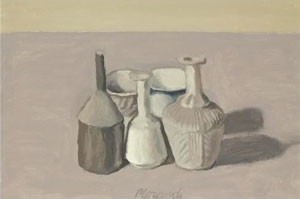
Giorgio Morandi (1890–1964) was an Italian painter and printmaker celebrated for a concentrated body of work that explores a few everyday objects with intense formal attention. Working mainly in Bologna, he made paintings and prints of bottles, vases, bowls, flowers and simple landscapes. Rather than dramatic subjects or narrative content, his art emphasizes subtle shifts of tone, proportion and spatial relationship, producing an atmosphere of quiet contemplation.
Image gallery
4 Images

Style and technique
Morandi's aesthetic is marked by restraint: a muted palette, careful modulation of light and shadow, and compact, ordered arrangements. He worked on modestly sized canvases and made numerous etchings and aquatints, treating printing as an extension of his pictorial concerns. Surfaces are often built through thin layers of paint and delicate brushwork that render minor changes in hue and value. The result is a sense of stillness and careful measurement rather than decorative flourish.
- Frequent motifs: bottles, jars, bowls, cups, simple flowers, and horizon-line landscapes.
- Common media: oil painting, etching and other printmaking processes; drawing played a continual role in studies.
- Characteristic qualities: tonal subtlety, spatial ambiguity, and repetition with variation.
Development and context
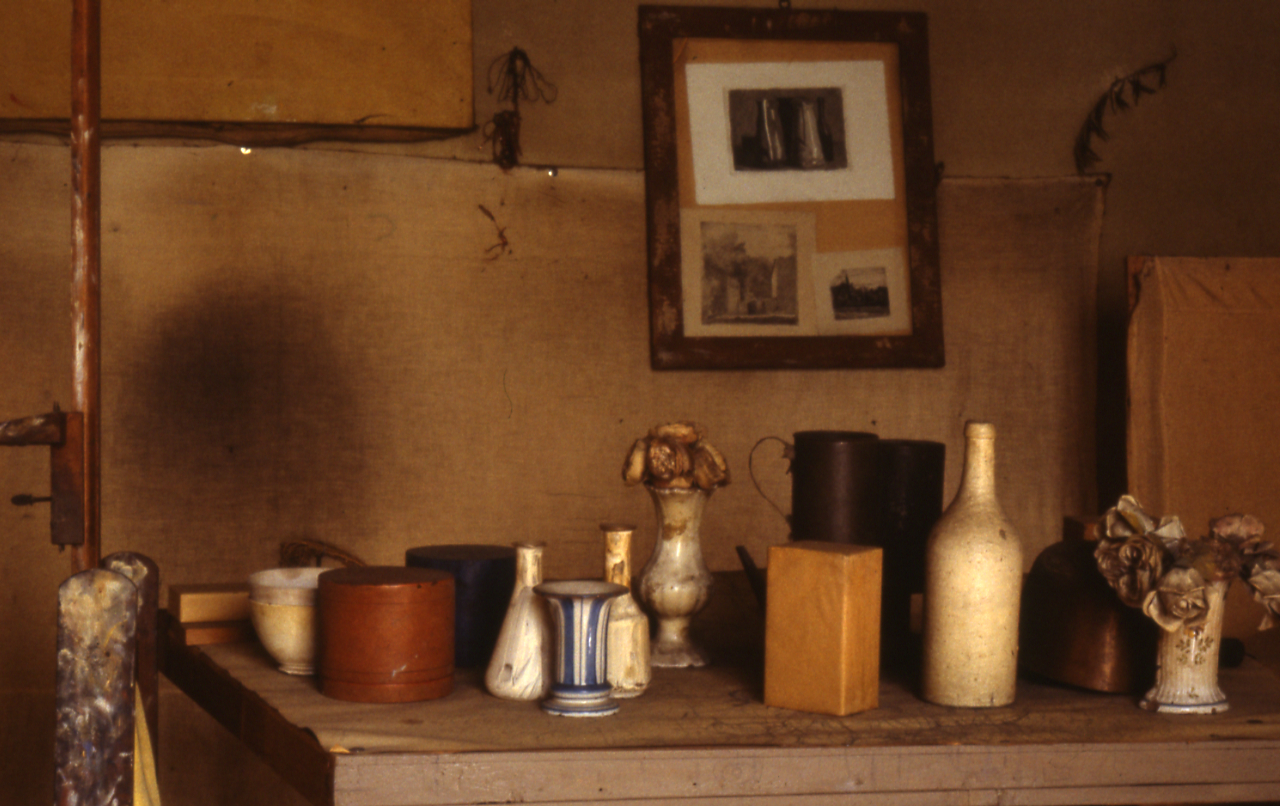
Morandi trained and worked within Italy's artistic circles but remained personally distant from grand movements or public spectacle. His early career included experiments with different modern currents, yet he soon narrowed his focus to the still life as a subject for persistent study. Over decades he returned to the same objects, rearranging them and varying light, colour and viewpoint to explore pictorial problems. He also produced prints that echoed and extended the concerns of his paintings; collectors and institutions began to recognize his quiet mastery during his lifetime.
Importance and legacy
Although his subjects are simple, Morandi's persistent study of form and tone has had lasting influence. Artists and critics frequently cite him in discussions of reduction, perception and the poetic possibilities of everyday objects. His work is often referenced in relation to minimalism and modernist concerns about structure and surface, and it continues to appear in exhibitions and publications. Critics emphasize how repetitive practice, rather than inventing new motifs, can deepen visual understanding.
Notable facts and distinctions
Morandi rarely relied on dramatic titles or explicit symbolism; his paintings are usually untitled or simply described, directing attention back to the visual problem itself. He balanced painting and printmaking throughout his career, and many collectors prize his subtle etchings alongside his oils. For further reading on his prints see printmaking resources, and for studies of his still lifes consult general texts on still life practice. His art stands as a model of how restraint and repetition can yield a deep and quietly powerful visual language.
Related articles
Author
AlegsaOnline.com Giorgio Morandi: Italian Painter and Printmaker Leandro Alegsa
URL: https://en.alegsaonline.com/art/119838