
Frei Otto
German architect and engineer known for pioneering lightweight, tensile and membrane structures; influential form-finding methods and ecological minimalism. Best known for the roof of the 1972 Munich Olympic Stadium.
Overview
Frei Paul Otto (31 May 1925 – 9 March 2015) was a German architect and structural engineer celebrated for developing lightweight, tensile and membrane structures. His work explored how minimal materials and clever geometry could produce large, efficient shelters with expressive forms. Otto combined architectural imagination with physical experimentation to create structures that are both economical and visually striking.
Image gallery
4 Images


Design approach and techniques
Otto pioneered a hands-on ‘‘form-finding’’ process that used hanging chain models, soap films and fabric prototypes to discover shapes that naturally resolve tension and compression. These methods exploited properties of minimal surfaces and catenary curves to determine efficient structural geometry before detailed calculation. He favored flexible membranes, cable nets and gridshells that achieve wide spans with very little mass.
Characteristics and materials
- Emphasis on tensile systems: roofs and canopies that carry loads mainly in tension.
- Use of lightweight membranes and cables, often translucent to soften daylight.
- Form-finding through physical models rather than imposing arbitrary shapes.
- Concern for economy of material and environmental sensitivity.
Notable works and examples
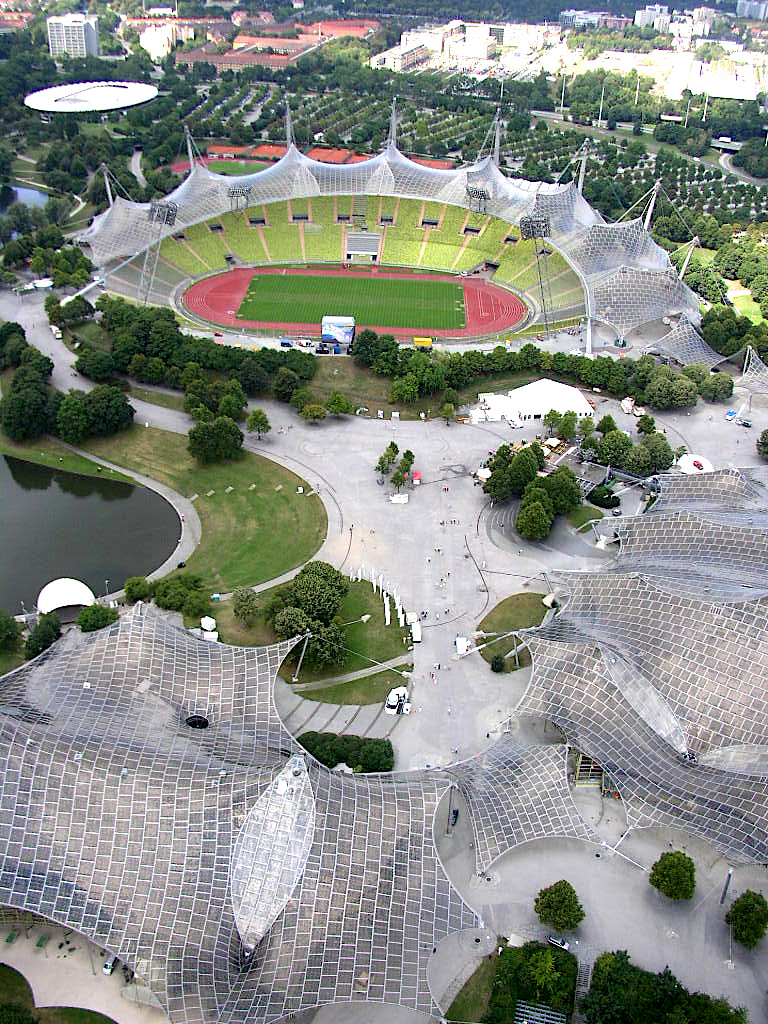
His most widely known built project is the sweeping tent-like roof of the 1972 Munich Olympic Stadium, executed in collaboration with other architects and engineers. Beyond iconic stadium roofs, Otto designed exhibition pavilions, research prototypes and demonstration shelters that showcased principles of minimal structure. Many of his projects served as experiments in large-span, low-mass construction and influenced later stadiums, canopies and temporary architecture.
Legacy and recognition
Otto taught and ran research groups that trained generations of architects and engineers in lightweight construction. He received major honors late in life, including the Pritzker Architecture Prize in 2015, announced shortly after his death. His techniques and philosophy continue to shape sustainable design thinking and the use of tensile systems in contemporary architecture. For further reading see additional resources.
Related articles
Author
AlegsaOnline.com Frei Otto Leandro Alegsa
URL: https://en.alegsaonline.com/art/119275
Sources
- pritzkerprize.com : "Biography: Frei Otto"