
Eduard Shevardnadze
Georgian politician and diplomat (1928–2014). Soviet foreign minister under Gorbachev and later President of independent Georgia (1995–2003), remembered for Cold War diplomacy and contested domestic rule.
Eduard Shevardnadze (25 January 1928 – 7 July 2014) was a Georgian politician and diplomat who played central roles both in late Soviet foreign policy and in the politics of independent Georgia. Internationally he is best known as the Soviet Union’s minister of foreign affairs during Mikhail Gorbachev’s reforms, a period when arms-control treaties and an easing of East–West tensions reshaped Europe. Domestically he later served as head of state and president of Georgia during the 1990s and early 2000s.
Image gallery
9 Images




Early life and rise in Georgian politics
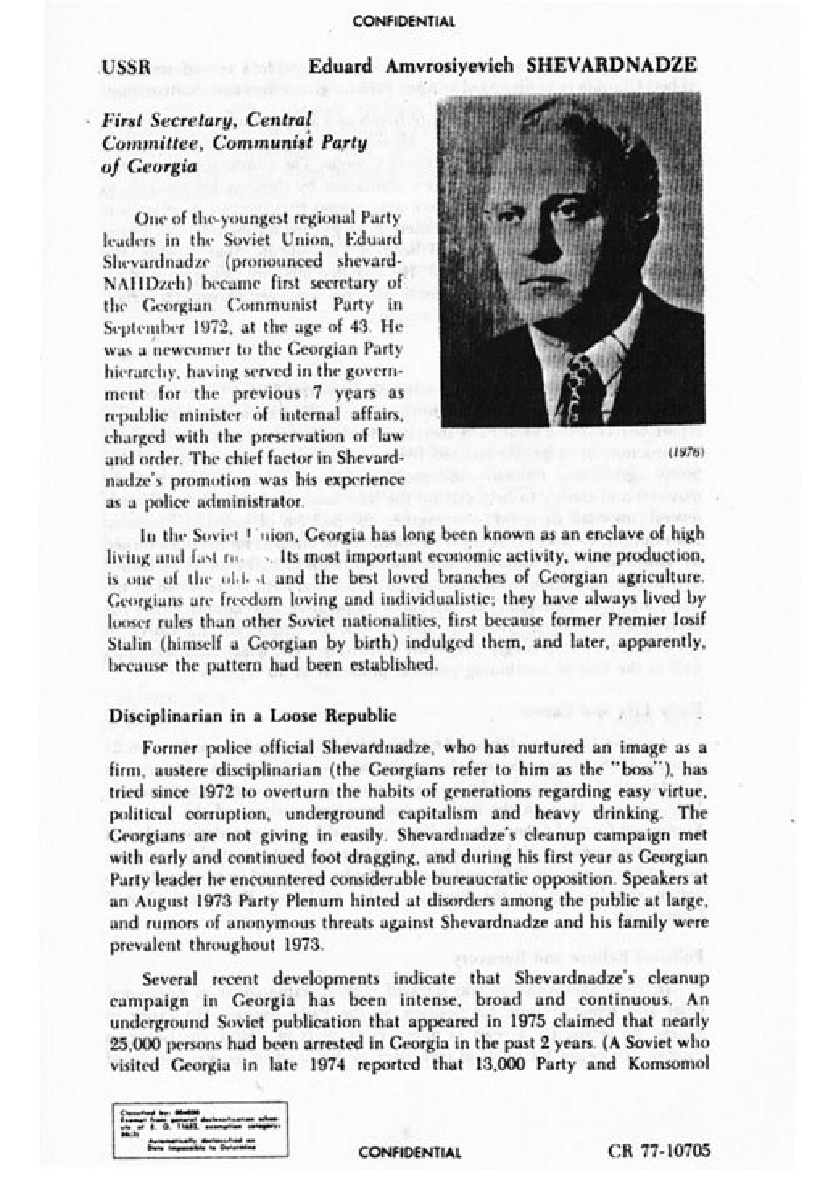
Born in the Georgian Soviet Socialist Republic, Shevardnadze came to prominence in the Georgian Communist Party and rose through regional administrative and party ranks. For more than a decade he was the First Secretary of the Georgian Communist Party, a position that made him the republic’s leading official. His colleagues often described him as skilled at managing local networks and navigating party structures. During this period he developed a reputation for pragmatic governance that would shape his later career.
Role in Soviet foreign policy
In 1985 Shevardnadze became minister of foreign affairs of the USSR. Working closely with perestroika and glasnost policies, he was a visible figure in diplomacy as the Cold War wound down. He helped negotiate arms-control agreements, supported efforts to reduce superpower confrontation, and accompanied Gorbachev to high-level summits. Observers credit him with helping to create diplomatic space for the political transformations of the late 1980s.
Leadership in independent Georgia
After the Soviet Union dissolved, Shevardnadze returned to Georgia and entered its turbulent post-Soviet politics. He became the country’s chief political figure in the early 1990s and was elected president in 1995. His domestic agenda combined attempts at economic reform and efforts to secure international recognition and assistance. However, his administration faced serious challenges: separatist conflicts in Abkhazia and South Ossetia, weak state institutions, and persistent allegations of corruption.
Resignation and later years
Shevardnadze’s presidency ended amid mass protests in late 2003 known as the Rose Revolution. Demonstrations over disputed parliamentary elections and demands for political renewal led him to resign. In retirement he remained a public figure and commentator on regional affairs until his death in 2014. Assessments of his later tenure emphasize a contrast between his international stature as a diplomat and the difficulties of governing a fragile, newly independent state.
Legacy and notable facts
- Widely recognized for his role in Soviet-era diplomacy and in easing Cold War tensions.
- Seen domestically as a transitional leader whose presidency mixed reform efforts with accusations of clientelism and corruption.
- Key offices: long-time Georgian party leader, Soviet foreign minister, and President of Georgia (1995–2003).
For references in Georgian and Russian contexts see the name forms often used in those languages: Georgian and Russian. For further reading on his political career and the presidency of Georgia consult general biography sources and country studies: biography resources and materials on the presidency of Georgia.
Related articles
Author
AlegsaOnline.com Eduard Shevardnadze Leandro Alegsa
URL: https://en.alegsaonline.com/art/118124
Sources
- bbc.com : Georgia ex-leader Shevardnadze dies