
Binary (base-2 numeral system)
Binary is the positional numeral system using two symbols (0 and 1). It forms the foundation of modern digital electronics and represents data in bits and bytes for computation, storage and communication.
Overview
Binary is a positional numeral system that uses only two digits, typically written as 0 and 1. Each binary digit represents an increasing power of two depending on its position. The smallest unit of binary information is the bit, and groups of bits form larger units such as bytes. Because it relies on only two states it is especially well suited to physical devices that can clearly distinguish between two conditions.
Image gallery
4 Images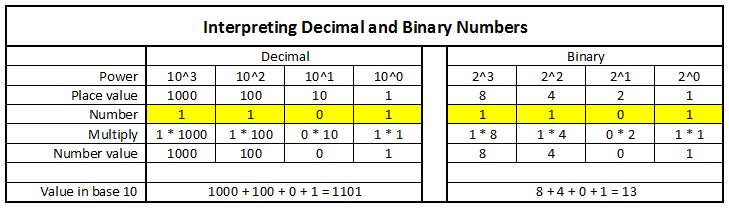


Notation and simple conversions
Binary numbers are normally annotated or understood as base 2 values to avoid confusion with decimal numbers. For example, the binary 1011 corresponds to 1×8 + 0×4 + 1×2 + 1×1 = 11 in decimal. Converting between binary and decimal involves summing powers of two for positions containing a 1; converting to binary from decimal uses repeated division by two. In text and engineering contexts binary groups may be shown with subscripts or tags indicating the base.
History and development
Ideas related to two-state representations have appeared in several traditions. Modern symbolic binary notation and systematic use of base two are often credited to early modern mathematicians who formalized positional arithmetic in the Western tradition. Independent cultural systems and philosophical writings also explored similar dual-pattern schemes long before electronic computers adopted binary as a practical standard.
Binary in computing and electronics
Digital computers use binary because electronic components naturally provide two stable states (for example, on/off, high/low voltage). Transistors and logic gates operate on binary signals, enabling arithmetic, comparison and control. Collections of bits encode numbers, characters (through schemes such as ASCII or Unicode), images, audio and compressed formats. For compact human-readable representations engineers often convert binary into hexadecimal or octal for diagnostics.
Characteristics, uses and examples
- As a number base, binary has simple carry rules: adding two 1s produces 10 (one carry, zero remainder).
- Groups: a nibble is 4 bits, a byte is 8 bits; larger aggregates form words of various lengths used by processors.
- Binary arithmetic underlies algorithms, error detection and correction, cryptography and data serialization.
- Alternative encodings exist (for instance, binary-coded decimal) where binary represents decimal digits directly for certain applications.
Because binary maps cleanly onto two-state hardware it remains the dominant representation for digital information. Understanding it provides a foundation for learning about programming, hardware design and data formats, and it explains why many computing conventions (bitwise operations, byte boundaries, binary flags) appear throughout technology.
Questions and answers
Q: What is binary?
A: Binary is a base 2 number system that uses two possible numbers: 0 and 1.
Q: Why is binary a base 2 system?
A: Binary is a base 2 system because it uses two possible numbers: 0 and 1.
Q: What is the difference between binary and decimal?
A: Binary is a base 2 system and uses two possible numbers, while decimal is a base 10 system and uses ten characters (0-9).
Q: Why do computers work in binary?
A: Computers work in binary because wires can store information in two different ways: by being powered, or not being powered.
Q: How can binary numbers be used?
A: Sets of binary numbers can be used to represent any information, such as text, audio, or video.
Q: How are binary numbers distinguished from decimal numbers?
A: Binary numbers are distinguished from decimal numbers by adding a subscript "(2)" when they are written.
Q: What characters are used in the decimal number system?
A: The decimal number system uses ten characters: 0-9.
Related articles
Author
AlegsaOnline.com Binary (base-2 numeral system) Leandro Alegsa
URL: https://en.alegsaonline.com/art/11587