
Binary form (music)
A musical structure in two related sections (A and B), common in Baroque dance movements and early keyboard sonatas; often features repeats and contrasting keys or themes.
Binary form is a structural pattern in Western art music in which a composition is organized into two main sections, conventionally labeled A and B. Each section often ends with a repeat sign, so performances typically present the sequence A–A–B–B. The term describes the broad outline rather than a single harmonic plan: the two sections may contrast in melody, harmony, texture or key while forming a single short movement or dance. For basic orientation and compositional guidance see resources for composers.
Image gallery
3 Images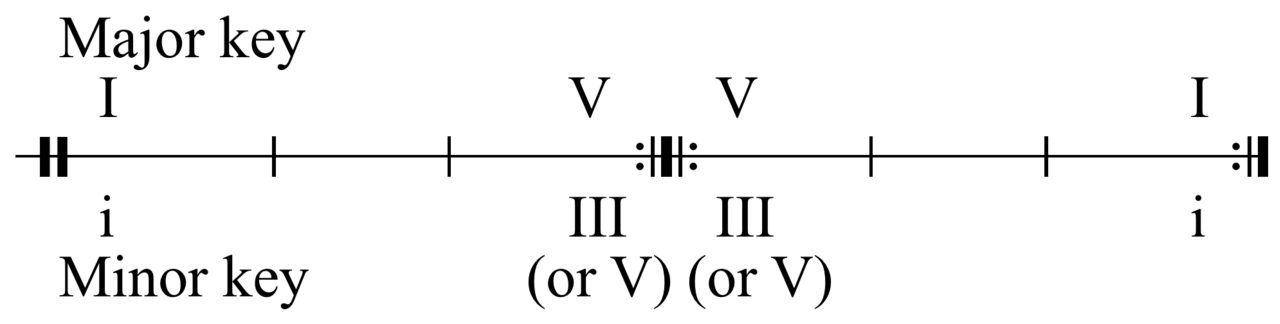


Characteristics
Typical features of binary-form movements include:
- Two clear sections (A and B) with internal repetition.
- Harmonic movement that often begins in the home key (tonic) and moves to a contrasting key in the B section (frequently the dominant or relative major/minor).
- Contrasts in thematic material or texture between the sections, while retaining motivic links.
- Notation with repeat signs and a double barline marking the section boundary.
History and development
Binary form became especially prominent during the Baroque era, when dances and suite movements used concise, two-part designs. Composers of the Baroque keyboard and instrumental repertoire frequently set minuets, allemandes, gigues and other dances in binary layouts. Later composers adapted and elaborated the idea: some pieces use a simple binary plan, while others create more complex hybrids that hint at or evolve into ternary or sonata forms. For historical context see materials on the Baroque repertoire and studies of early sonata movements for keyboard.
Uses and examples
Binary form is common in short instrumental movements and keyboard sonatas of the 17th and 18th centuries. Many dance movements from suites and early classical minuets follow this two-part layout, making it a practical design for both composition and performance. Well-known keyboard works and pedagogical pieces often employ binary structure because it balances repetition with contrast.
Variants and distinctions
There are several subtypes of binary form. "Simple binary" keeps distinct material in each section without a return of the opening theme. "Rounded binary" features a return or partial return of A material at the end of the B section, producing a sense of closure. "Balanced binary" emphasizes parallel cadential material at the ends of both sections. Binary form differs from ternary (ABA) form, where the first section returns unchanged, and from sonata-allegro form, which develops themes in a larger, developmental process.
Understanding binary form helps performers recognize repeats, cadence points and tonal direction, and it assists listeners in following the formal plan of many short classical pieces.
Related articles
Author
AlegsaOnline.com Binary form (music) Leandro Alegsa
URL: https://en.alegsaonline.com/art/11581
Sources
- britannica.com : "Binary form"