
1870s
The 1870s was a pivotal decade of wars, national consolidation, economic upheaval and cultural innovation, highlighted by German unification, the Long Depression, and advances in communications, science and the arts.
The 1870s covers the years 1870 through 1879. It was a transitional decade in which nineteenth‑century industrialization, nation‑building and imperial expansion accelerated while new technologies and cultural movements began to reshape everyday life. Political boundaries, economic systems and social expectations were contested and reconfigured in ways that helped shape the modern era.
Image gallery
8 Images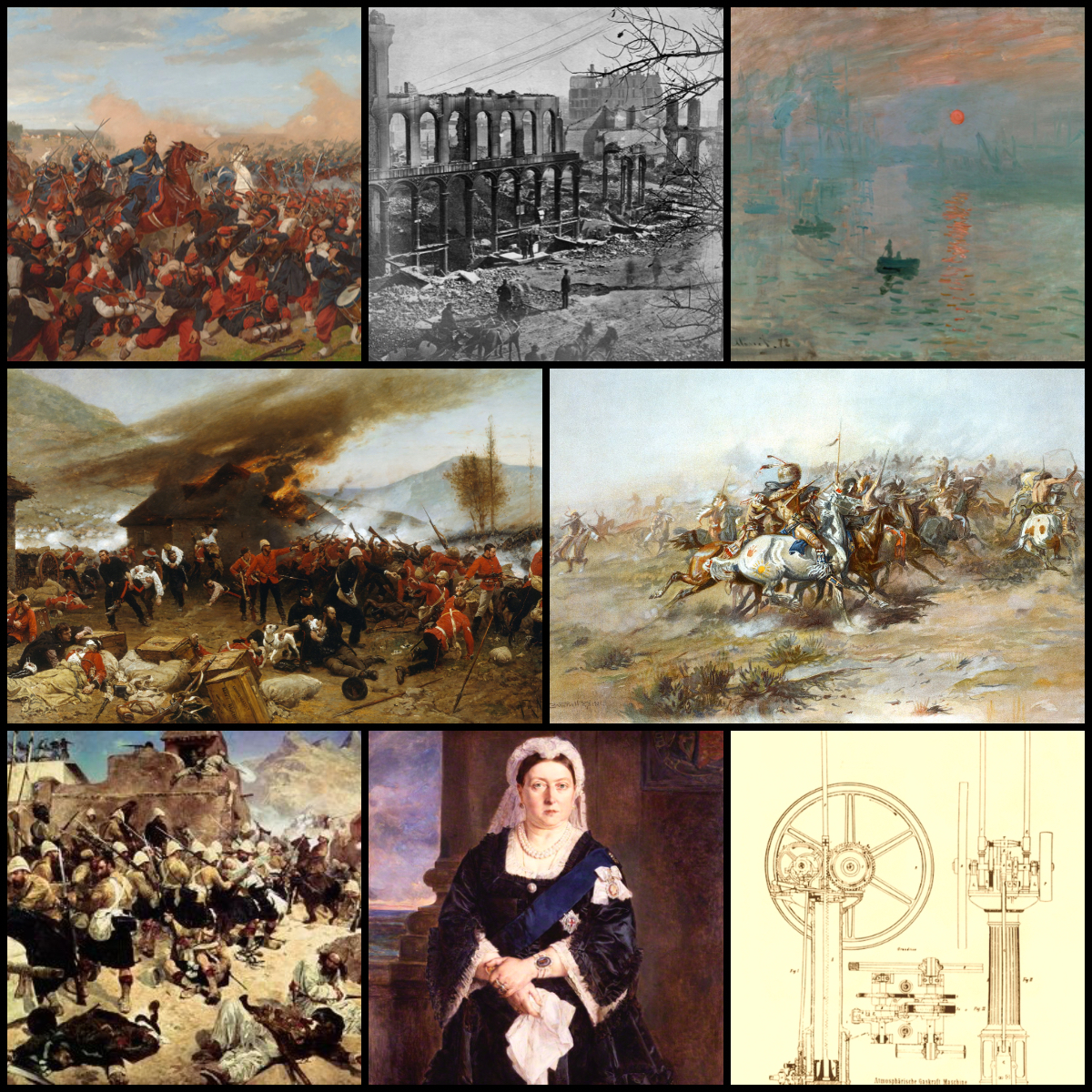




Politics and conflict
Major wars and diplomatic shifts defined the decade. The Franco‑Prussian War (1870–1871) led to the fall of the Second French Empire and the proclamation of the German Empire, altering the balance of power in Europe. The Paris Commune of 1871 was a short‑lived experiment in radical urban self‑government that influenced later socialist movements. The Russo‑Turkish War (1877–1878) and its diplomatic aftermath at the Congress of Berlin (1878) reshaped southeastern Europe. In Italy, the capture of Rome in 1870 completed the unification process begun earlier in the century. Outside Europe, imperial expansion and resistance continued: the Great Sioux War (including the 1876 Battle of the Little Bighorn), the Anglo‑Zulu War (1879) and the Satsuma Rebellion in Japan (1877) were among conflicts linked to state consolidation and colonial pressure. The disputed U.S. presidential election of 1876 and the Compromise of 1877 effectively ended Reconstruction in the United States.
Science, technology and industry
The decade saw important practical inventions and growing industrial networks. Alexander Graham Bell patented the telephone in 1876 and Thomas Edison introduced the phonograph in 1877 and worked toward a practical incandescent lamp by 1879, steps that transformed communication and entertainment. Telegraph and railway systems continued to expand across continents, steamship lines increased long‑distance migration and trade, and industrial production and factory systems spread. Scientific debates and advances in biology, chemistry and physics increasingly informed medicine and engineering, while the acceptance of germ theory and antiseptic practice grew among practitioners.
Economy, infrastructure and daily life
The Panic of 1873 triggered a prolonged global downturn often called the Long Depression. It revealed vulnerabilities in international credit, speculative railroad investment and commodity markets, and contributed to social tensions. Many governments and private investors nonetheless continued to finance large infrastructure projects—railroads, ports and telegraph lines—and large waves of emigration from Europe to the Americas continued, reshaping demography in receiving countries. Urbanization accelerated, and mass‑market newspapers, periodicals and the telegraph made political life and commerce more immediate.
Culture, ideas and society
Artistic and intellectual life also shifted. The first Impressionist exhibition in Paris (1874) signalled new directions in painting, and authors, composers and thinkers responded to rapid social change. Charles Darwin published The Descent of Man in 1871 and debates over evolution and society continued. Labor movements, trade unions and early social reform campaigns grew in many countries as industrial workforces expanded; women’s rights and social reform efforts advanced unevenly in different regions.
Legacy and notable facts
The 1870s left enduring legacies: the emergence of a united Germany and reorganized Balkan states reshaped diplomacy; technological advances laid groundwork for mass communication and electrification; and artistic movements that began in the decade influenced the development of modernism. The decade thus stands as a bridge between mid‑nineteenth‑century empires and the intensifying global conflicts and innovations of the twentieth century.
- Notable events: Franco‑Prussian War, Paris Commune, Panic of 1873, Russo‑Turkish War (1877–78) and Congress of Berlin, First Impressionist Exhibition (1874), U.S. Centennial Exposition (1876), capture of Rome (1870), War of the Pacific beginning (1879).
- Notable figures: Otto von Bismarck, Alexander Graham Bell, Thomas Edison, Claude Monet and other Impressionists, Charles Darwin (post‑Origin publications), leaders and activists across Europe, Asia and the Americas.
Related articles
Author
AlegsaOnline.com 1870s Leandro Alegsa
URL: https://en.alegsaonline.com/art/111835