
1644 — A Year of Civil War, Revolt, and Dynastic Change
Overview of 1644, a year of decisive military and political shifts: the fall of Ming Beijing and the Manchu advance in China, key battles of the English Civil War, and cultural responses across Eurasia.
Overview
1644 saw decisive military and political shifts across Eurasia. In China the long crisis of the late Ming reached a turning point when peasant rebellion and foreign intervention combined to overthrow the capital regime. In the British Isles the struggle between crown and parliament produced major battles that shifted control of regions and accelerated political change. Intellectual life and print culture reacted quickly to these conflicts, leaving a record of competing arguments about authority, liberty and order.
Image gallery
10 Images
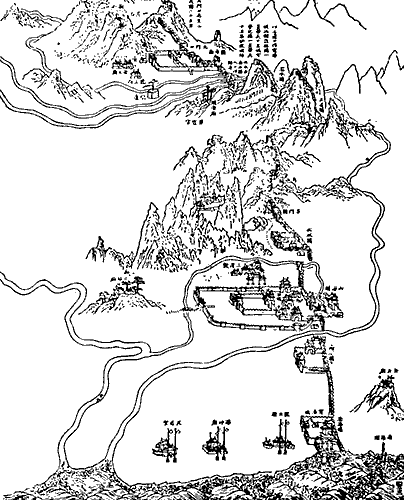


China: fall of Beijing and the Manchu advance
In April 1644 the rebel leader Li Zicheng captured Beijing after a prolonged uprising; the Chongzhen Emperor died as the city fell. Ming general Wu Sangui's decision to admit Manchu forces through the Shanhai Pass led to the defeat of Li's army and the occupation of the capital by the Manchus, who established the Qing dynasty and began a large-scale conquest of China. Ming loyalist regimes endured in the south for years, and resistance and local accommodations shaped a protracted transition in governance, population movements and elite culture.
British Isles: battles and political consequence
The English Civil War produced significant engagements in 1644. The Battle of Marston Moor (July) was a major Parliamentarian and allied Scottish victory that effectively handed the north of England to anti-Royalist forces. The Second Battle of Newbury (October) was tactically inconclusive but costly to both sides and underlined the war's grinding nature. Campaigns in Scotland and Ireland continued to complicate the conflict, while wartime mobilization and factional politics pushed debates about sovereignty and religious settlement.
Ideas, print culture and wider context
Printed pamphlets and political tracts proliferated as partisans sought to justify their positions. John Milton's Areopagitica (1644) stands out as an early and influential defense of freedom from prior censorship. Across continental Europe the Thirty Years' War was still under way, and the mid‑17th century more generally saw war, rebellion and diplomatic realignment that reshaped states and societies.
Notable consequences
- The capture of Beijing and the Chongzhen Emperor's death symbolized the collapse of Ming authority in the capital and opened the way for Qing rule.
- Marston Moor is widely regarded as a turning point that weakened Royalist prospects in England.
- Proliferating political writing in 1644 contributed to evolving concepts of press freedom, legitimacy and public opinion.
- Events of 1644 fit a broader 17th‑century pattern in which sustained warfare accelerated state formation, religious settlement, and social change.
Although 1644 did not end the wider conflicts of the era, it produced clear inflection points: military outcomes that year shaped subsequent campaigns and political settlements, while regime change and intellectual debate set longer-term cultural and institutional trajectories in both Europe and East Asia.
Related articles
Author
AlegsaOnline.com 1644 — A Year of Civil War, Revolt, and Dynastic Change Leandro Alegsa
URL: https://en.alegsaonline.com/art/111580