
1292 (year and number)
Overview of 1292 as an integer and as the calendar year AD 1292: arithmetic properties, divisors and notation; and historical highlights including the selection of John Balliol and papal developments.
The term 1292 can refer either to the integer that follows 1291 and precedes 1293, or to the calendar year AD 1292. Both senses appear in historical, mathematical and cultural contexts. This article summarizes the number's basic arithmetic properties and notable facts, and sketches the principal events and significance of the year 1292 in medieval Europe.
Image gallery
1 Image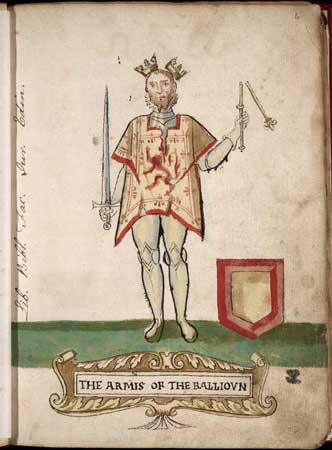
As an integer
In arithmetic, 1292 is an even composite number. Its prime factorization is 2^2 × 17 × 19, which gives it a total of 12 positive divisors. It is not a perfect square or cube. The sum of all positive divisors (the sigma function) equals 2520, so the sum of proper divisors is 1228, which is less than 1292; accordingly the number is classed as deficient.
- Prime factorization: 2^2 × 17 × 19
- Positive divisors: 1, 2, 4, 17, 19, 34, 38, 68, 76, 323, 646, 1292
- Binary: 10100001100; Hexadecimal: 0x50C; Roman numerals: MCCXCII
As the year AD 1292
The year 1292 sits in the late thirteenth century, a period marked by shifting power relations in Europe and continuing Mongol influence across Eurasia. One of the best-known events of 1292 concerns Scotland: after the death of Margaret, the Maid of Norway, a succession dispute known as the "Great Cause" was resolved with the selection of John Balliol as King of Scots. Edward I of England played a decisive role in choosing and recognizing Balliol, a development that soon contributed to tensions leading up to the Wars of Scottish Independence.
In the papal realm, 1292 saw the death of Pope Nicholas IV, producing a prolonged vacancy of the papal throne and intense political negotiation among cardinals and secular rulers. Across the continent, the year formed part of an era of legal, commercial and military consolidation: urban trade networks expanded, royal administrations became more systematic, and regional conflicts reconfigured medieval polities.
Because it is both a simple integer and a label for a historical year, 1292 appears in diverse sources — from lists of divisors and computational examples to chronologies of medieval events. Its arithmetic features (especially the neat factorization 4 × 17 × 19 and the relation to the familiar number 2520) make it convenient in elementary number-theory examples, while the events of AD 1292 connect to larger narratives about state formation and church politics in medieval Europe.
Questions and answers
Q: What is the significance of the year 1292?
A: The text indicates that something important happened in that year, but the specific event or significance is not stated.
Q: Does the text provide any context or background information for 1292?
A: No, the text simply states the year.
Q: Is there any indication of the location or culture being referred to in the text?
A: No, the text is too brief to provide any information about location or culture.
Q: Is it possible that the year 1292 is being referenced in a historical or literary context?
A: Yes, it is possible, but without further context it is impossible to determine what event or work may be referenced.
Q: Could the year 1292 be significant in a religious, scientific, or artistic context?
A: Yes, it is possible, but without more information it is impossible to determine in what way.
Q: Are there any numbers associated with 1292 that might provide a clue about its significance?
A: None are immediately apparent from the text.
Q: Is it possible that the year 1292 is significant only to a specific individual or group, and not widely known or regarded as important historically?
A: Yes, it is possible that the year has greater significance to one person or group than to others or in a broader historical context.
Related articles
Author
AlegsaOnline.com 1292 (year and number) Leandro Alegsa
URL: https://en.alegsaonline.com/art/111215