
Zilog Z80 microprocessor
An 8-bit microprocessor introduced in 1976 that powered many 1980s home computers and continues in embedded applications; noted for 8080 compatibility and an extended instruction set.
Overview
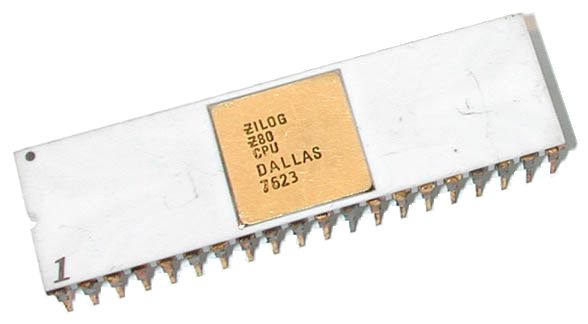
The Z80 is an 8-bit microprocessor family first introduced by Zilog in 1976. It gained widespread use through the late 1970s and 1980s as a compact, inexpensive CPU for home computers, business machines and electronic products. The Z80 combined backward compatibility with the Intel 8080 instruction set and additional instructions and features that made it attractive to system designers.
Image gallery
10 Images


Design and notable features
The architecture extends the basic 8-bit register model with several enhancements aimed at ease of programming and system integration. Important characteristics include additional index registers, alternate register sets for fast context switching, and instructions that simplify block moves and string operations. The device also incorporated support for dynamic RAM refresh and a flexible interrupt structure, features that reduced the need for external glue logic in many designs.
History and production
Zilog developed and launched the Z80 in the mid 1970s. Volume production and licensing agreements led to second-source manufacturing by a number of semiconductor companies worldwide; for example, variants were produced by firms such as Sharp, Toshiba and NEC. Over time Zilog and other vendors produced faster CMOS versions and pin-compatible updates while third parties produced derivatives for specific markets.
Uses, influence and examples
The Z80 became a staple of many early personal and home computers, as well as video game hardware and industrial controllers. Its relative software compatibility with earlier designs and the expanded instruction set encouraged a large ecosystem of operating systems, compilers and hobbyist projects. Decades after its introduction the core design principles continued to influence microcontroller and embedded CPU choices.
Variants and legacy
- Commercial CMOS and higher-speed grades offered improved power and performance for new applications.
- Successor and enhanced families, along with compatible derivatives, extended the Z80 line for specialized uses.
- The architecture remains in production and use; many modern embedded products still rely on Z80-derived parts for control functions and legacy compatibility (embedded systems).
Today the Z80 is regarded as a classic microprocessor: influential in the formative years of personal computing and enduring in niches where its instruction set, cost, or ecosystem remain advantageous.
Related articles
Author
AlegsaOnline.com Zilog Z80 microprocessor Leandro Alegsa
URL: https://en.alegsaonline.com/art/110316