
Wilson's bird-of-paradise
A small, vividly colored bird-of-paradise endemic to a few Indonesian islands; noted for the male's ornate plumage, elaborate courtship displays, and conservation importance.
Overview
Wilson's bird-of-paradise is a small passerine of the family Paradisaeidae, celebrated for the male's striking and highly specialized plumage and for an elaborate courtship display. The species is restricted to a small area of eastern Indonesia, and its unusual appearance and behavior have made it a focus of natural history and conservation attention.
Image gallery
2 Images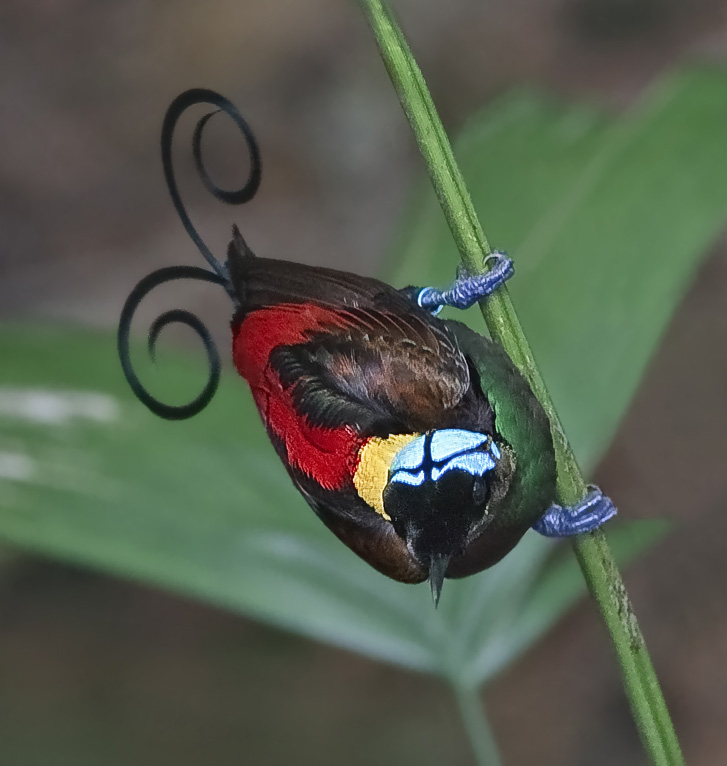

Description and sexual dimorphism
Males and females differ markedly. Males bear a complex palette of bright and iridescent colors, with areas of bare facial skin and highly modified feathers used in display. Females have cryptic, camouflaged plumage that helps conceal them at nests. The pronounced differences between sexes reflect strong sexual selection acting on male ornamentation and display performance.
Courtship and behavior
Males perform highly choreographed displays on small cleared courts on the forest floor or on low branches. These routines include precise movements, postures that expose flank and tail ornaments, and repetitive sequences intended to attract and persuade visiting females. Males typically display alone and do not assist with nest building or chick rearing.
Habitat and distribution
The species is endemic to a limited island group in eastern Indonesia, where it inhabits lowland and hill rainforests with a complex understory. It favours areas that combine closed canopy for foraging and small open patches suitable for display. Its restricted range makes the species especially sensitive to habitat change.
Diet and ecological role
Wilson's bird-of-paradise feeds on fruit and a variety of small animals such as insects and other arthropods. By consuming fruit, it contributes to seed dispersal across the forest; by taking invertebrates it influences local arthropod communities. Its life history is closely tied to the structure and diversity of intact tropical forest.
Reproduction and life history
After courtship, the female is solely responsible for nest construction, incubation and care of the young. Nests are typically placed in sheltered positions within the forest understory. Clutch size is small, and reproductive success is influenced by predation, food availability and habitat quality.
Conservation and threats
The species is of conservation concern because of its small geographic range and dependence on forest habitat. Habitat loss, fragmentation and degradation are primary threats. Conservation responses emphasise habitat protection, management of forest landscapes and support for sustainable local livelihoods and ecotourism that can provide incentives to conserve native forest.
Cultural and scientific significance
Wilson's bird-of-paradise remains an emblematic example of sexual selection and evolutionary elaboration in birds. Its dramatic appearance has long attracted interest from scientists, naturalists and nature-oriented visitors, and it functions as an important species for raising awareness about tropical forest conservation.
Related articles
Author
AlegsaOnline.com Wilson's bird-of-paradise Leandro Alegsa
URL: https://en.alegsaonline.com/art/108412