
Widows (2018 film)
Widows is a 2018 heist thriller directed by Steve McQueen. An ensemble drama about four women in Chicago who plan a robbery after their husbands are killed, examining political corruption, class and grief.
Overview
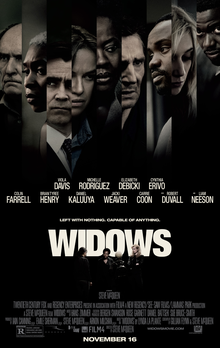
Widows is a 2018 crime heist film directed by Steve McQueen. Set in contemporary Chicago, the story follows four women who are left to confront the consequences of a failed robbery in which their husbands were killed. The film repurposes and expands an idea from the 1980s British television series of the same name by Lynda La Plante, relocating the premise to the United States and combining the mechanics of a genre heist drama with broader political and social concerns.
Image gallery
5 Images


Plot and structure
The narrative moves between the procedural aspects of planning and executing a robbery and a character-driven study of grief, agency, and survival. The protagonists face obstacles that include rival criminal interests, police attention, and the interference of political actors, and the screenplay balances sequences of preparation and confrontation with quieter moments that reveal the pressures and compromises faced by the women. Rather than foregrounding action spectacle, the film often emphasizes stakes grounded in relationships, debt, and the social networks that constrain the characters.
Production and writing
Co-written by Steve McQueen and novelist-screenwriter Gillian Flynn, the film reshapes elements of its television predecessor for a contemporary American audience. The creative team sought to integrate topical themes—urban inequality, institutional corruption, and gendered expectations—into a conventional heist structure. Production values emphasize controlled pacing, a deliberate visual style, and a focus on performance; cinematography, production design, and editing work together to maintain tension while allowing space for character development.
Casting and performances
The film features an ensemble cast whose performances became a major focus of critical response. Leading the group is Viola Davis, supported by Michelle Rodriguez, Elizabeth Debicki, and Cynthia Erivo. The ensemble also includes notable supporting performances from Colin Farrell, Brian Tyree Henry, Daniel Kaluuya, Jacki Weaver, Carrie Coon, Robert Duvall, and Liam Neeson. Reviewers commonly highlighted how the actors convey the film’s ethical ambiguities and emotional weight, and how strong performances anchor scenes that might otherwise read simply as crime-thriller set pieces.
Themes and analysis
Widows foregrounds several intersecting themes. It uses the heist narrative as a means to explore political power, the distribution of resources, and the ways institutions respond to crisis. Race and gender are present as structural elements of the story: the protagonists confront expectations about who belongs in positions of agency and how society evaluates their choices. The film also interrogates the idea of legitimacy—what actions are deemed criminal versus politically acceptable—and how violence and governance can become entangled.
Release and reception
Distributed by 20th Century Fox, Widows opened in late 2018, with release dates including early November in the United Kingdom and a mid-November release in the United States. Critics responded positively overall, praising the ambition of marrying a genre framework to topical social critique and noting the cast’s performances. While responses varied on pacing and tonal shifts, the film earned notice for attempting to operate on multiple levels: as a suspenseful crime story, a political drama, and a study of personal loss and moral compromise.
Legacy and interpretation
Beyond its box-office run, Widows has become a reference point in discussions about contemporary genre filmmaking that seeks to engage with civic and social issues. It is frequently cited in analyses of how adaptations can be reimagined across cultures and periods, and how the heist film can serve as a vehicle for reflecting on inequality and institutional failure. For many viewers the film's lasting appeal lies in its blend of ensemble acting, moral complexity, and an approach that treats the heist as one symptom of broader social problems rather than as an isolated spectacle.
Further reading
- Production interviews and critical essays explore the film’s adaptation choices and political dimensions; look for director and writer commentary for insight into their intentions.
- Cast-focused pieces examine individual performances and the dynamics of an ensemble-driven narrative.
- Comparative studies contrast the film with the original television series to trace what elements were retained, reframed, or newly introduced in the American remake.
Related articles
Author
AlegsaOnline.com Widows (2018 film) Leandro Alegsa
URL: https://en.alegsaonline.com/art/107965
Sources
- bbfc.co.uk : "WIDOWS (15)"
- boxofficemojo.com : "Widows (2018)"
- rte.ie : "Widows: Viola Davis sparkles in this superb modern noir"
- firstpost.com : "Widows review round-up: Steve McQueen's heist film is a 'ferociously entertaining crowd-pleaser'"
- editorial.rottentomatoes.com : "Fantastic Beasts: The Crimes of Grindelwald Could Use a Bit More Magic"