
Welsh orthography: alphabet, spelling rules and diacritics
Overview of Welsh writing: the Latin-based alphabet with digraphs, spelling conventions, diacritics (especially the circumflex), historical development and practical uses.
Overview
Welsh orthography is the standardized system for writing the Welsh language with letters derived from the Latin script. It reflects a close relationship between spelling and pronunciation: many Welsh letters correspond to consistent sounds, and the language preserves several letter combinations that represent single phonemes. Welsh spelling is important culturally and administratively across Wales and in Welsh-language education.
Image gallery
2 Images
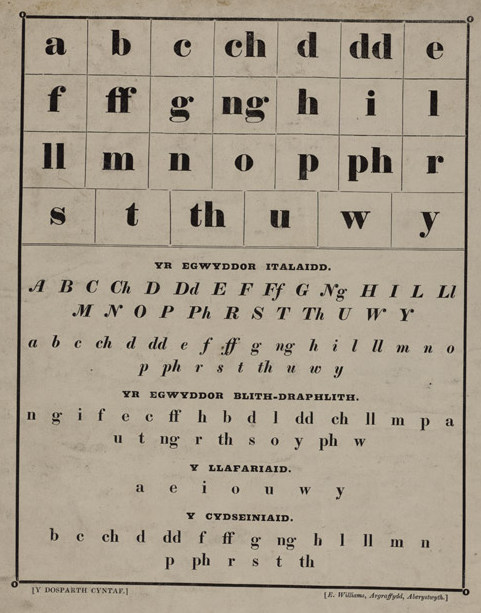
The alphabet and digraphs
The contemporary Welsh alphabet traditionally comprises 28 units, including eight digraphs that are treated historically as single letters for purposes such as collation. The conventional sequence is: a, b, c, ch, d, dd, e, f, ff, g, ng, h, i, (j), l, ll, m, n, o, p, ph, r, rh, s, t, th, u, w, y. The letter j has become common in modern lists because of its use in loanwords from English and other languages; inclusion is now generally accepted though some traditional lists omit it. In traditional collation the digraphs ch, dd, ff, ng, ll, ph, rh and th occupy single places in the alphabetic order, a feature sometimes handled differently by modern computer systems.
Spelling conventions and notable letters
Welsh treats w and y as vowels in addition to the five classic vowel letters a, e, i, o, u. Their values vary by position and dialect — for example, w often represents a close back vowel similar to English "oo". Consonant letters include several that represent sounds uncommon in English orthography, such as ll, a voiceless lateral fricative, and ng as a velar nasal. Because the orthography links spelling closely to phonology, learners quickly benefit from predictable letter–sound correspondences.
History and orthographic change
Modern Welsh spelling developed in the early modern period as printers and scholars sought a consistent system for religious, educational and legal texts. Decisions made in the 16th century influenced which letters remained in common use; for example certain letters fell out of regular printing usage and others were adapted to represent native sounds. Debates over the inclusion of particular letters and the handling of loanwords continued into later centuries, and orthographic reform and standardization have been gradual. Historical documents such as early translations of the New Testament and subsequent dictionaries played a central role in standardizing forms now seen in modern Welsh.
Diacritics and pronunciation marks
The most visible diacritic in Welsh is the circumflex, commonly used to indicate a lengthened vowel in a word; linguists and language learners often associate it with a long vowel quality. Other diacritic marks, such as the acute, grave or diaeresis, appear less frequently and tend to serve specialist or lexical purposes: for example, to mark stress, to distinguish homographs, or to show that two adjacent vowels should be pronounced separately rather than as a diphthong.
Practical use and distinctions
Welsh orthography interfaces with grammar through features such as initial consonant mutation, where the first consonant of a word changes in predictable ways in different grammatical contexts; these changes are written as standard letters and are an integral part of how words are spelled in sentences. The orthography is used in education, signage, media and computing; modern keyboards and software increasingly support Welsh-specific characters and collation rules, though legacy limitations sometimes affect ordering of digraphs. Understanding the alphabet, digraphs and diacritics is central to literacy in Welsh and to accurate representation of names, place-names and technical vocabulary.
- Alphabet and digraphs: ch, dd, ff, ng, ll, ph, rh, th.
- Vowels include: a, e, i, o, u, w, y — with w and y functioning as vowels.
- Common diacritic: circumflex (marks long vowel).
- Loanwords from English and other languages bring in forms using loanwords orthography conventions.
Further reading and resources on spelling rules, pronunciation charts and historical texts are available from language authorities and educational bodies that document the development and practical application of Welsh orthography.
More about the Welsh language • Loanword handling • English influence • Historical texts • Diacritics overview • Circumflex details • Vowel length and quality
Questions and answers
Q: How many letters are in the traditional Welsh alphabet?
A: There are 28 letters in the traditional Welsh alphabet.
Q: Which letters are treated as digraphs in the Welsh alphabet?
A: The digraphs treated as single letters for collation in the Welsh alphabet are ch, dd, ff, ng, ph, rh, th, and ll.
Q: Is the letter "j" included in the Welsh alphabet?
A: The letter "j" is not traditionally included in the Welsh alphabet, but is now often included due to its use in loanwords from English.
Q: Which letters are used in some technical terms in Welsh?
A: The letters "k", "v", "x", and "z" are used in some technical terms in Welsh.
Q: Can Welsh letters replace the letters "k", "v", "x", and "z"?
A: Yes, Welsh letters can often replace the letters "k", "v", "x", and "z" in Welsh.
Q: Why was the letter "k" dropped from the Welsh alphabet?
A: The letter "k" was dropped from the Welsh alphabet at the time of the publication of the New Testament in Welsh because the printers did not have enough "k" letters.
Q: What is the most common diacritic used in the Welsh language?
A: The most common diacritic used in the Welsh language is the circumflex, which is used in some cases to mark a long vowel.
Author
AlegsaOnline.com Welsh orthography: alphabet, spelling rules and diacritics Leandro Alegsa
URL: https://en.alegsaonline.com/art/107237