
Weimar Constitution (Constitution of the German Reich)
The constitution that framed the Weimar Republic (1919–1933), establishing democratic institutions, civil rights and a strong presidency whose emergency powers later shaped Germany's political fate.
Overview
The constitution of the German Reich, commonly called the Weimar Constitution, was adopted after World War I to organize the German state that existed between 1919 and 1933. Written and proclaimed in the city of Weimar, it sought to create a democratic republic with broad civil liberties, universal suffrage and parliamentary institutions. Its German title was Die Verfassung des Deutschen Reiches and it is often described simply as the Weimar Constitution. It remained the formal constitution of Germany until replacement after World War II, even while the Nazi regime operated from 1933 to 1945.
Image gallery
2 Images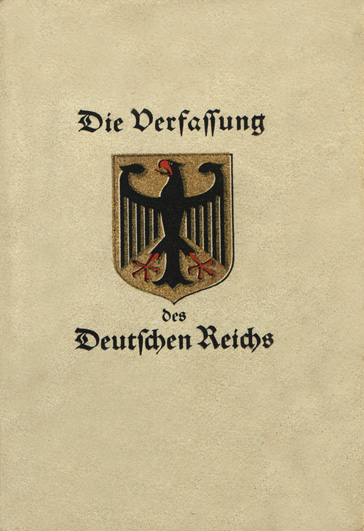

Structure and key provisions
The document combined parliamentary elements with a powerful, directly elected head of state. It guaranteed a range of individual rights, social protections and political liberties, and it established national organs such as a popularly elected parliament and a federal council representing constituent states. Women received the vote and basic social and economic rights were recognized.
- Proportional representation aimed to reflect diverse political views in the legislature.
- A directly elected president held reserve powers to appoint governments and act in emergencies.
- Civil liberties and welfare-oriented clauses were included to respond to social demands after the war.
Historical development
Drafted in the chaotic aftermath of imperial collapse, the constitution reflected competing pressures: democratic reformers, socialists, conservatives and federal state interests. It was framed through debates about how to balance effective leadership with parliamentary control. The document proved influential but also contested from the start, as political fragmentation, economic crises and social unrest challenged stable governance.
Importance and consequences
The Weimar Constitution inaugurated Germany's first sustained experiment with broad democratic rule and introduced progressive legal protections. However, certain features—most notably the broad emergency authority granted to the president—were later used to bypass regular parliamentary processes. Political fragmentation produced by proportional representation made durable majorities difficult, which in combination with crises contributed to the erosion of democratic norms in the early 1930s.
Legacy and distinctions
Historians and legal scholars recognize the constitution for its progressive aspirations and for structural weaknesses that were exploited during the collapse of the parliamentary system. Its experience influenced the drafting of postwar German law, which sought to preserve fundamental rights while adding safeguards against authoritarian misuse of emergency powers. For more on the constitutional text and its context see a general discussion of the term constitution and material on the Weimar Republic.
Related articles
Author
AlegsaOnline.com Weimar Constitution (Constitution of the German Reich) Leandro Alegsa
URL: https://en.alegsaonline.com/art/107154