
Wedge (simple machine and shape)
A wedge is a triangular or trapezoidal simple machine that converts an applied force into separating, lifting, or holding forces. This article covers mechanics, design, history and common uses.
Overview
A wedge is a piece of material, typically triangular in cross section, that converts a force applied to its blunt end into forces perpendicular to its inclined surfaces. It is one of the classical simple machines and can be considered a moving inclined plane: pushing or striking the wedge drives its faces between or beneath material, producing separation, lifting, or clamping actions.
Image gallery
1 Image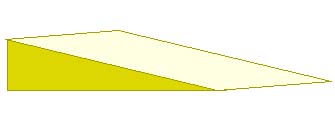
Mechanics and mechanical advantage
Key geometric parameters are the wedge length (the slope) and its thickness at the thick end. In an ideal, frictionless model the mechanical advantage approximates the ratio of the slope length to thickness: a long, thin wedge gives greater theoretical advantage. In real applications friction, surface finish, and material deformation reduce efficiency. The wedge angle—the angle between the two faces—affects performance: smaller angles concentrate force and split material more effectively but increase the risk of jamming or damage to the wedge.
Design, materials and limitations
Wedges are made from materials chosen for strength, toughness and wear resistance: wood and stone for ancient wedges; iron, steel and tungsten alloys for cutting tools and industrial splitters. Surface hardness, edge geometry and heat treatment influence sharpness retention. Designers balance angle, tip radius and face finish to suit tasks; for example, carving chisels have different bevels than log-splitting wedges. Limitations include material fatigue, dulling, and the need for sufficient backing force to drive the wedge through the workpiece.
History and development
Early humans used sharpened stone, bone and antler wedges for cutting and splitting. The adoption of metalworking produced durable blades and specialized tools such as axes, knives and chisels. Over centuries, improvements in metallurgy and manufacturing refined wedge geometry for consistent performance in woodworking, metalworking and construction.
Common uses and examples
- Cutting and shaping: knives, axes, chisels, plane irons and scissors rely on wedge geometry to separate material.
- Splitting: wood wedges and splitting mauls amplify hammer blows to split logs along grain.
- Fastening and adjustment: shims and tapered wedges position or lock assemblies in place.
- Industrial applications: hydraulic and mechanical splitters use scaled wedge principles in mining, demolition and rock splitting.
Other senses and distinctions
The term "wedge" appears in many contexts: wedge-shaped footwear, certain golf clubs called wedges, geological wedges formed by erosion, and metaphorical uses such as "wedge issue" in politics. In mathematics the wedge symbol names operations like the exterior (wedge) product. It is also useful to distinguish a wedge from a screw: both derive from the inclined plane, but a screw converts rotational motion into linear motion while a wedge converts linear motion into separating forces.
Related articles
Author
AlegsaOnline.com Wedge (simple machine and shape) Leandro Alegsa
URL: https://en.alegsaonline.com/art/107107