
Wat Pho — Temple of the Reclining Buddha in Bangkok
Wat Pho (Wat Phracheatupon Vimonmungkraram) is Bangkok’s largest and oldest temple complex, famed for its 46 m reclining Buddha, extensive chedi field, and as the historic center for Thai massage and traditional medicine.
Wat Pho, formally Wat Phracheatupon Vimonmungkraram and commonly called the Temple of the Reclining Buddha, is one of Thailand’s best known religious complexes. Located in the Phra Nakhon district near the Grand Palace, it functions as a major site of worship, a cultural landmark, and a long-standing center for traditional education. Many travel guides and cultural overviews list it among the most significant Buddhist temples in Thailand.
Image gallery
10 Images



Main features and layout
The compound contains an extensive array of structures and decorations, dominated by the enormous reclining image that gives the site its popular name. The image measures about 46 m in length (roughly 151 ft), and about 15 m high. The figure is gilded and its eyes and fingernails are inlaid with mother-of-pearl; the soles of the feet are decorated with intricate mother-of-pearl panels illustrating 108 auspicious scenes. Surrounding the Reclining Buddha are cloisters, open halls, and court buildings that serve both religious and educational functions.
Pagodas, stupas and royal memorials
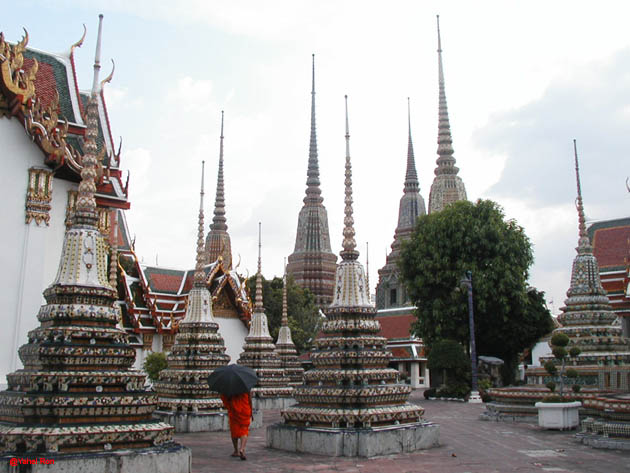
Wat Pho is also noted for its large group of chedis or pagodas, traditionally counted as ninety-nine, which form an important visual and ritual field across the compound. Several of these stupas are dedicated to members of the Chakri royal family, and a small number are particularly associated with the reigns of Kings Rama I, Rama II and Rama IV. The density and decorative richness of these chedis make Wat Pho one of the most architecturally complex temple sites in Bangkok.
History and development
The site existed in various forms before the foundation of the current Bangkok era. Originally a monastic complex in the Ayutthaya period, it was extensively rebuilt and expanded at the start of the Rattanakosin period by King Rama I in the late 18th century, who raised its status and renamed it. Subsequent monarchs, most notably Rama III, undertook large campaigns of decoration and repair during the nineteenth century, adding many masonry structures and the elaborate ornamentation visible today. King Rama IV also made notable changes to the temple’s formal name and patronage.
Thai massage, education and cultural role
Wat Pho is celebrated as the birthplace and main historic center for traditional Thai massage and medicine within the kingdom. The temple complex long served as a place of practical instruction in medicine, traditional therapies and Buddhist learning; its walls contain a range of medical inscriptions, diagrams and murals that were used as teaching aids. The modern Wat Pho Thai Traditional Medical and Massage School continues this legacy, offering courses in therapeutic massage and related disciplines, and the name Thai massage is frequently associated with the temple’s educational reputation.
Visiting, preservation and notable facts
Wat Pho is a major destination for both worshippers and visitors. Its Reclining Buddha, gilded surfaces, mother-of-pearl inlays and the field of pagodas attract cultural, religious and architectural interest. The temple remains an active monastery and a place of ceremony; visitors are expected to observe customary dress and behaviour in sacred spaces. Conservation and restoration work has been carried out periodically to protect the gilding, murals and stone inlays that make the site distinctive. Among notable facts often cited about the complex are the monumentally scaled Reclining Buddha, the expansive collection of chedis, and the temple’s historic function as a center for practical education and traditional healing.
- Primary dedication: Reclining Buddha image and monastic complex.
- Major architectural elements: gilded statue, mother-of-pearl feet, cloisters, stupas/pagodas.
- Historical highlights: rebuilt under Rama I, decorated under Rama III, renamed under Rama IV.
- Cultural role: repository of medical inscriptions and a historic school of Thai massage.
- Further reading and visitor guidance: see official and tourist sources for practical information (conservation and artifacts), site maps and opening hours (pagoda layout), and local context in central Bangkok or national temple lists (Thailand). Additional cultural and scholarly resources are indexed at regional repositories and guides (Buddhist temple resources, metric details, imperial-unit details).
Related articles
Author
AlegsaOnline.com Wat Pho — Temple of the Reclining Buddha in Bangkok Leandro Alegsa
URL: https://en.alegsaonline.com/art/106757
Sources
- sacred-destinations.com : "Wat Pho"
- dhammathai.org : "Temple Praechtupn pure Magclaram Rachwrmhawihar"