
War Office — British Army administration and its legacy
Former British government department responsible for the administration of the British Army; later integrated into a unified Ministry of Defence in the mid‑20th century.
The War Office was the name given to the British government department that administered the land forces of the United Kingdom. For much of its existence it managed policy, finance and organisation for the British Army, overseeing recruitment, training, supply and the careers of officers and soldiers. Its responsibilities made it the central civil authority for the Army until defence functions were brought together under a single ministry in the mid‑20th century.
Image gallery
3 Images

Organisation and functions
The War Office combined civilian and military leadership. A senior minister in civilian government—the Secretary of State for War—had political responsibility, while professional military officers advised on operations and capability. Typical duties included:
- Personnel administration and pay
- Recruitment, training institutions and doctrine
- Procurement and supply of equipment and stores
- Logistics, transport and barracks management
- Policy formation and coordination with other government departments
History and development
The War Office evolved from older forms of military administration rather than appearing as a single instant creation. Over the 18th and 19th centuries its role became progressively formalised as Britain expanded its global commitments and professionalised its forces. Major wars and inquiries prompted periodic reforms of structure and practice, and the department adapted to the needs of large expeditionary and garrison forces, particularly during the world wars of the 20th century.
Uses, examples and importance
As the administrative hub for the Army the War Office handled mobilisation for overseas campaigns, maintained regimental systems, and directed supply chains that sustained operations at home and abroad. Its decisions affected colonial garrisons, expeditionary corps and domestic defence arrangements. During large-scale conflicts the War Office worked closely with field commanders and other ministries to coordinate manpower and materiel.
Distinct institutions and eventual merger
The War Office was one of three separate service ministries; the Royal Navy answered to the Admiralty and the air arm to the Air Ministry. In the early 1960s those independent departments were reorganised into a single, unified body to improve joint planning and control. This consolidation created the modern Ministry of Defence, bringing land, sea and air administration under one roof.
Legacy and notable facts
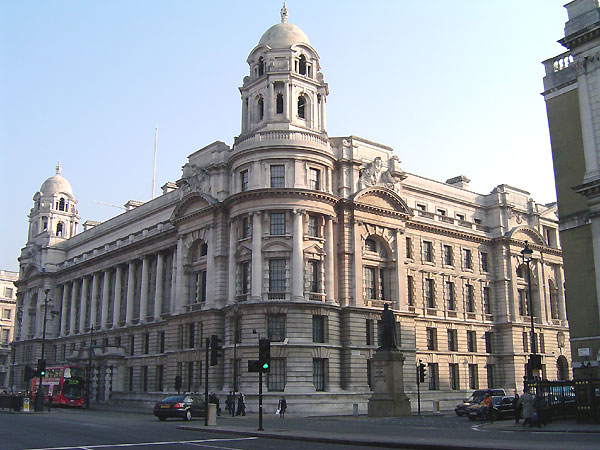
The War Office left an architectural and institutional legacy: its headquarters and records remain points of interest for historians of military affairs and public administration. The name endures in historical writing about British military organisation, and its reforms and practices influenced how modern defence ministries structure civilian oversight of armed forces.
Related articles
Author
AlegsaOnline.com War Office — British Army administration and its legacy Leandro Alegsa
URL: https://en.alegsaonline.com/art/106505