
Vjosa River: a wild transboundary river of Greece and Albania
The Vjosa (Aoös) rises in Greece's Pindus range and flows west to the Adriatic through Albania. Noted for its largely free‑flowing course, braided channels, and recent conservation attention.
Overview
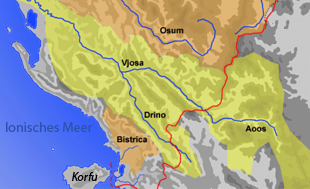
The Vjosa (known in Greece as the Aoös) is a transboundary river that rises in the Pindus Mountains of Greece and flows west into the Adriatic Sea. It runs roughly 272 km from upland springs and mountain valleys through a sequence of rocky gorges, braided floodplains and a sandy coastal delta. The river crosses international borders and plays an important ecological and cultural role in both countries.
Image gallery
9 Images


Characteristics
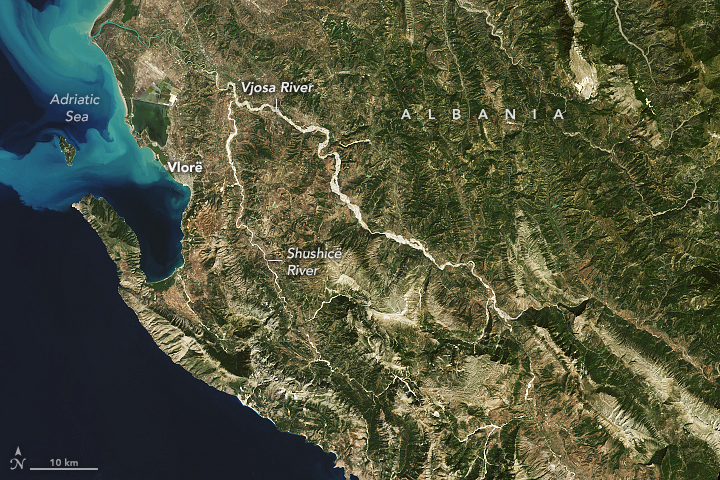
Physically the Vjosa displays contrasting landscapes along its course. In the upper reaches in Greece it cuts deep canyons through limestone and metamorphic rocks, while downstream in Albania it becomes a broad, shifting corridor of gravel bars, side channels and wetlands before emptying into the Adriatic Sea. These changes create diverse habitats and dynamic sediment transport patterns.
Importance and uses
- Ecology: the river supports wetlands, fish populations and riparian vegetation that depend on natural flow variation.
- Human uses: local communities rely on it for irrigation, small‑scale fishing, and recreation such as rafting and birdwatching.
- Development pressures: proposals for hydropower and river engineering have prompted debate over balancing energy needs and conservation.
History and protection
Historically the Vjosa corridor has been a route for people and wildlife between inland mountains and the coast. In recent years the river has attracted international conservation attention because large stretches remain largely free‑flowing—an increasingly rare condition in Europe. Environmental campaigns and policy debates have led to increased legal protection and management efforts to preserve the river's natural dynamics and biodiversity.
Location and notable facts
The lower Vjosa shapes the coastal plain south of the city of Fier and north of Vlorë, and in places forms administrative boundaries between local municipalities, including areas near Fier and Vlorë. Its Greek name, Aoös, and Albanian form, Vjosë, reflect the river's cross‑border character and shared natural heritage. Conservationists often cite the Vjosa as one of Europe's last large rivers that still exhibits much of its natural pattern of channels and seasonal floods.
For further reading and maps see local conservation resources and country environmental agencies via these references: Vjosa overview, Albania information, Greek sources, Adriatic context, and regional planning documents.
Related articles
Author
AlegsaOnline.com Vjosa River: a wild transboundary river of Greece and Albania Leandro Alegsa
URL: https://en.alegsaonline.com/art/105712