
Virtual International Authority File (VIAF)
A cooperative service that clusters authority records from national libraries and other institutions to provide shared identifiers and cross‑links for personal, corporate, and title names.
Overview
The Virtual International Authority File (VIAF) is a collaborative service that aggregates and reconciles name authority records created by national libraries and large bibliographic organizations. Its main purpose is to reduce duplication and confusion by linking variant name forms and source records to a single, machine‑readable identifier, commonly called a VIAF ID.
Image gallery
1 Image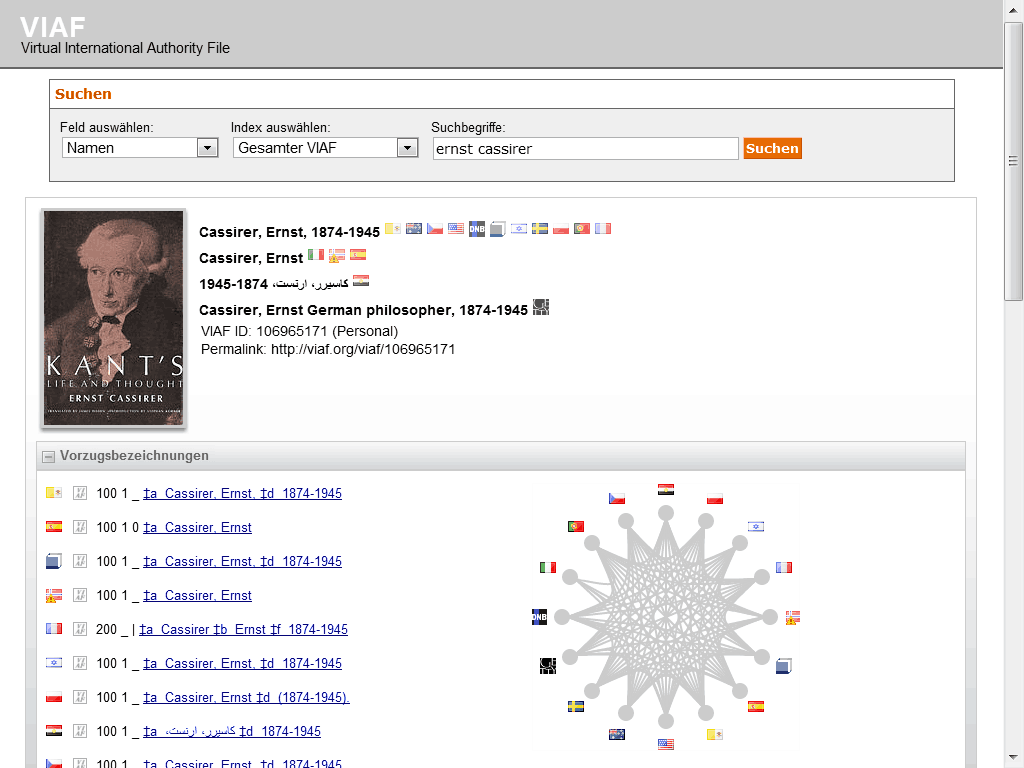
Record structure and contents
VIAF does not replace national authority files; it clusters them. A typical VIAF cluster brings together multiple source records that represent the same person, corporate body, or title. Elements commonly found in VIAF records include:
- Preferred name form and alternate forms in different languages and scripts
- Dates, roles, and brief qualifiers
- Links back to the contributing authority records
- Machine‑readable identifiers that enable integration with other systems
History and development
Originating from cooperation among several national libraries and bibliographic organizations, VIAF was developed to address the long‑standing problem of name ambiguity across catalogs. The project grew as more institutions contributed authority data, and its infrastructure evolved to support bulk downloads and programmatic access for library systems and researchers.
Uses and importance
VIAF is used by catalogers, libraries, publishers, and digital humanities projects to disambiguate names, link records across systems, and support discovery. Examples include unifying author names in library catalogs, improving search results, and enabling connections between bibliographic metadata and external datasets in the semantic web.
Distinctive features and limitations
Unlike a single national authority file, VIAF is an international aggregation that preserves links to each contributing source. It complements other identifier systems used in cultural heritage and research. Limitations include uneven coverage (reflecting participating sources), potential clustering errors where distinct entities are mistakenly merged, and dependency on updates from contributing institutions.
Practical access
VIAF provides both human‑readable record views and machine interfaces that let organizations incorporate VIAF identifiers into catalogs, bibliographies, and linked‑data applications. Its identifiers help make names interoperable across languages, scripts, and information systems.
Related articles
Author
AlegsaOnline.com Virtual International Authority File (VIAF) Leandro Alegsa
URL: https://en.alegsaonline.com/art/105575