
Union Stock Yards (Chicago)
The Union Stock Yards were Chicago’s central meatpacking district from 1865 to 1971; a rail-linked industrial complex that shaped the U.S. meat industry, inspired reform, and left a lasting cultural legacy.
The Union Stock Yard & Transit Company, commonly called the Union Stock Yards or simply "The Yards," was the concentrated meatpacking and livestock handling district in what is now the New City neighborhood of Chicago, established in 1865. Built where rail lines converged, it centralized slaughterhouses, holding pens and distribution facilities so animals could be moved, processed and shipped in large volume. The complex grew to become a defining element of Chicago’s industrial identity and a focal point of national debates about labor, food safety and urban change.
Image gallery
10 Images
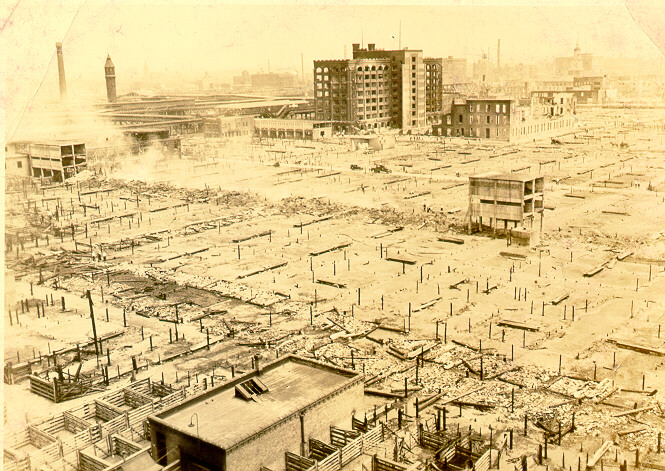


Characteristics and organization
The Yards combined several interdependent elements designed for high-volume meat processing. These included extensive stock pens for cattle, hogs and sheep; large-scale packinghouses where animals were slaughtered and butchered; refrigeration and cold-storage facilities; and rail terminals to receive livestock and ship finished products. Major meatpacking firms such as Swift and Armour operated large plants there, alongside many smaller contractors. The design emphasized specialization, mechanized workflows and proximity to transportation networks, which reduced handling time and costs.
History and development
The stock yards were organized shortly after the Civil War and benefited from Chicago’s role as a national rail hub. Financial backing from eastern capital helped establish the necessary infrastructure, and the enterprise expanded rapidly as western cattle reached Chicago by rail. Growth continued through the late 19th and early 20th centuries, and into the 1920s Chicago processed more meat than any other single city. The Yards’ prominence peaked in the 1920s, with 1924 often cited as a landmark year for volume of trade.
Economic and social impact
The Union Stock Yards were a major employer and incubator of industrial practices that influenced the global meat trade. They stimulated related industries — refrigeration, railcar manufacturing, packaging and distribution — and contributed to Chicago’s rise as a commercial metropolis. At the same time, working conditions, immigrant labor concentrations and sanitation practices in and around the Yards attracted criticism and scrutiny. The district and its conditions inspired writers and reformers; notably, the plight of workers and the state of food processing helped spur public awareness when Upton Sinclair drew attention to the industry in his 1906 novel The Jungle.
Decline and closure
Several factors led to the Yards’ long decline in the mid-20th century. Changes in transportation, the decentralization of slaughtering and packing operations, shifts in livestock production patterns, and technological advances made smaller regional plants more viable. Over the decades the volume of activity diminished, and the Union Stock Yards finally closed on July 30, 1971. The site’s industrial role largely ended, though its influence on urban labor, industry organization and food systems persisted.
Legacy and recognition
Though the physical complex no longer functions as it once did, the Union Stock Yards remain an important part of Chicago’s history. The area is associated with the neighborhood often called Packingtown, and its story is intertwined with late 19th–early 20th-century immigration, industrialization and reform movements dating back to the period after the Civil War. The significance of the site has been recognized by preservation authorities: it was designated a Chicago Landmark in 1972 and later listed as a National Historic Landmark in 1981. Today the Yards are remembered for their role in shaping modern meatpacking, urban labor history, and American food regulation, as well as for their deep imprint on Chicago’s cultural memory. For more local context see references to the New City area (New City) and to early financial backers such as the Vanderbilts (Vanderbilt).
Related articles
Author
AlegsaOnline.com Union Stock Yards (Chicago) Leandro Alegsa
URL: https://en.alegsaonline.com/art/102916
Sources
- encyclopedia.chicagohistory.org : "Union Stock Yard"
- bartleby.com : "1. Chicago"
- encyclopedia.chicagohistory.org : Meatpacking
- ci.chi.il.us : "Chicago Landmarks" · web.archive.org
- cr.nps.gov : "National Historic Landmarks Survey: Listing of National Historic Landmarks by State: Illinois"
- tps.cr.nps.gov : "Old Stone Gate, Chicago Union Stockyards" · web.archive.org