
Ugyen Wangchuck — first King of Bhutan and founder of the Wangchuck dynasty
Ugyen Wangchuck (1862–1926) unified Bhutan after civil conflict and was chosen its first hereditary monarch in 1907, modernizing governance and shaping relations with British India and Tibet.

Overview
Gongsa Ugyen Wangchuck (1862–1926) was a Bhutanese statesman who became the first hereditary monarch of Bhutan in 1907. Rising from the position of Penlop (governor) of Trongsa, he consolidated power during a period of internal strife and established the Wangchuck dynasty, which continues to reign. His reign combined traditional authority with selective modernization and careful diplomacy toward neighbouring powers.
Image gallery
6 Images


Rise to power
Born into a prominent family, Ugyen Wangchuck succeeded his father as Penlop of Trongsa and built a power base in central Bhutan. From this centre he subdued competing regional lords through a combination of military action and alliances, bringing relative stability after a series of civil wars and rebellions in the late 19th century. In 1907, representatives from the major religious and secular communities met at Punakha and unanimously selected him as hereditary monarch, creating a central authority where power had previously been diffuse.
Reign: governance and reforms
As king, Ugyen Wangchuck sought to strengthen central government while preserving Bhutan's Buddhist institutions. He reorganized administrative practices, appointed trusted officials to key posts, and promoted internal order. His approach was pragmatic: he maintained traditional structures, such as the monastic hierarchy, while encouraging modest reforms to fiscal management and law to improve governance and state capacity.
Foreign relations and honours
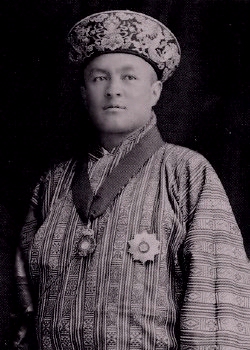
Ugyen Wangchuck cultivated a pragmatic relationship with British India, using diplomacy to secure Bhutan's interests and external security. He acted as an intermediary during events connected with the 1904 Younghusband expedition to Lhasa and gained British trust for his cooperative stance. In recognition of these services he received British honours, being appointed Knight Commander of the Order of the Indian Empire in 1904 and later elevated to Knight Grand Commander in 1921. A formal understanding with British India in 1910 clarified the Himalayan kingdom's foreign relations and provided regular financial subsidies while acknowledging Bhutan's internal autonomy.
Notable actions and legacy
- Founded a hereditary monarchy that stabilized national governance and reduced factional warfare.
- Balanced preservation of Buddhist institutions with administrative modernization.
- Established lasting diplomatic ties with British India that shaped Bhutan's 20th-century external policy.
Context and significance
Ugyen Wangchuck's reign marked the transition of Bhutan from a fragmented collection of regional polities to a unified, if small, Himalayan state with a central monarch. His cautious reforms and diplomatic skill laid foundations for later developments: his son succeeded him as the second king, continuing the Wangchuck line. Historians view his period as one in which Bhutan secured survival and relative independence amid competing regional powers by choosing careful accommodation rather than confrontation.
For further background on the regions and events linked to his career see accounts of his power base in central Bhutan: central Bhutan, the 1904 mission often described as the Younghusband expedition to Lhasa: Younghusband Expedition, and broader histories of Tibet and its relations with neighbouring states: Tibet.
Dates and honours (selected)
- Born 1862; died 1926.
- Chosen King of Bhutan, 1907.
- KCIE (1904); GCIE (1921).
Questions and answers
Q: Who was Gongsa Ugyen Wangchuck?
A: Gongsa Ugyen Wangchuck was the first King of Bhutan from 1907 to 1926.
Q: When was Gongsa Ugyen Wangchuck born?
A: Gongsa Ugyen Wangchuck was born in 1862.
Q: Who were Gongsa Ugyen Wangchuck's parents?
A: Gongsa Ugyen Wangchuck's parents were Jigme Namgyal, Penlop of Trongsa, and Ashi Pema Choki.
Q: How did Gongsa Ugyen Wangchuck become the Penlop of Trongsa?
A: Gongsa Ugyen Wangchuck succeeded his father as Penlop of Trongsa.
Q: What did Gongsa Ugyen Wangchuck do to unite Bhutan and defeat his political enemies?
A: From his power base in central Bhutan, Gongsa Ugyen Wangchuck defeated his political enemies and united the country following several civil wars and rebellions in 1882-1885.
Q: What was Gongsa Ugyen Wangchuck's role in mediating between the British and Tibetans?
A: Gongsa Ugyen Wangchuck played a role in mediating between the British and Tibetans during the Younghusband Expedition to Lhasa, Tibet.
Q: What honors were bestowed upon Gongsa Ugyen Wangchuck by the British?
A: For his services in mediating between the British and Tibetans, Gongsa Ugyen Wangchuck was knighted by the British in 1904 and appointed Knight Grand Commander of the Order of the Indian Empire (GCIE) in the 1921 New Year Honours.
Related articles
Author
AlegsaOnline.com Ugyen Wangchuck — first King of Bhutan and founder of the Wangchuck dynasty Leandro Alegsa
URL: https://en.alegsaonline.com/art/102593
Sources
- thegazette.co.uk : "No. 32178"