
Type 91 105 mm howitzer (Imperial Japanese Army artillery piece)
A 105 mm towed howitzer adopted by the Imperial Japanese Army in the early 1930s, used for divisional and corps-level fire support through the Second Sino-Japanese War and World War II.
The Type 91 105 mm howitzer was a towed artillery piece adopted by the Imperial Japanese Army (IJA) in the early 1930s to provide medium-calibre indirect fire support. Commonly called a "10-cm" gun in Japanese sources despite its 105 mm bore, the Type 91 served as a standard howitzer for infantry divisions and artillery regiments and saw extensive use in the campaigns of the 1930s and 1940s.
Image gallery
7 Images


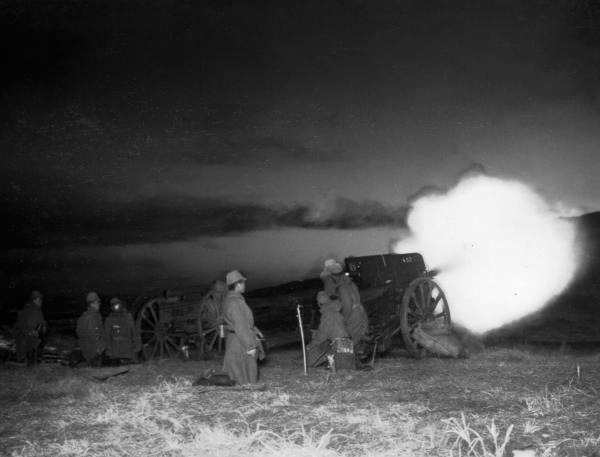
Design and characteristics
The weapon combined a rifled steel barrel with a recoil system and a wheeled carriage suitable for horse or motor traction. It was designed to deliver high-explosive and shrapnel shells in plunging and direct-fire roles, supplementing lighter field guns and providing greater destructive effect against entrenched positions.
- Calibre: classified as 10 cm in Japanese nomenclature (actual bore 105 mm).
- Carriage: towable design allowing deployment with divisional artillery units.
- Ammunition: types intended for fragmentation and explosive effect.
History and operational use
Named "Type 91" according to the Imperial year system (2591 = 1931), the howitzer was adopted as part of Japan's modernization of its artillery arm. It saw action throughout the Second Sino-Japanese War and in Pacific and Southeast Asian theatres of World War II. Units employed the Type 91 for preparatory bombardments, counter-battery fire, and close support of infantry assaults.
Like many contemporaneous pieces, it was used in both horse-drawn formations and later motorized columns as logistics and mechanization evolved. Its role was complementary to lighter 75 mm field guns and heavier siege artillery, filling the medium-range, medium-explosive niche in Japanese force structure.
For further context on howitzers in general, see field artillery. Information on the organization that deployed this weapon is available under Imperial Japanese Army.
Related articles
Author
AlegsaOnline.com Type 91 105 mm howitzer (Imperial Japanese Army artillery piece) Leandro Alegsa
URL: https://en.alegsaonline.com/art/102339
Sources
- books.google.com : Japanese Army in World War II: Conquest of the Pacific 1941-42, p. 50
- books.google.com : "Model 91 (1931) 105-mm howitzer,"