
To Anacreon in Heaven (Anacreontic Song)
An 18th-century convivial song written for London's Anacreontic Society; its tune by John Stafford Smith was later paired with Francis Scott Key's poem to become the melody of the U.S. national anthem.
Overview
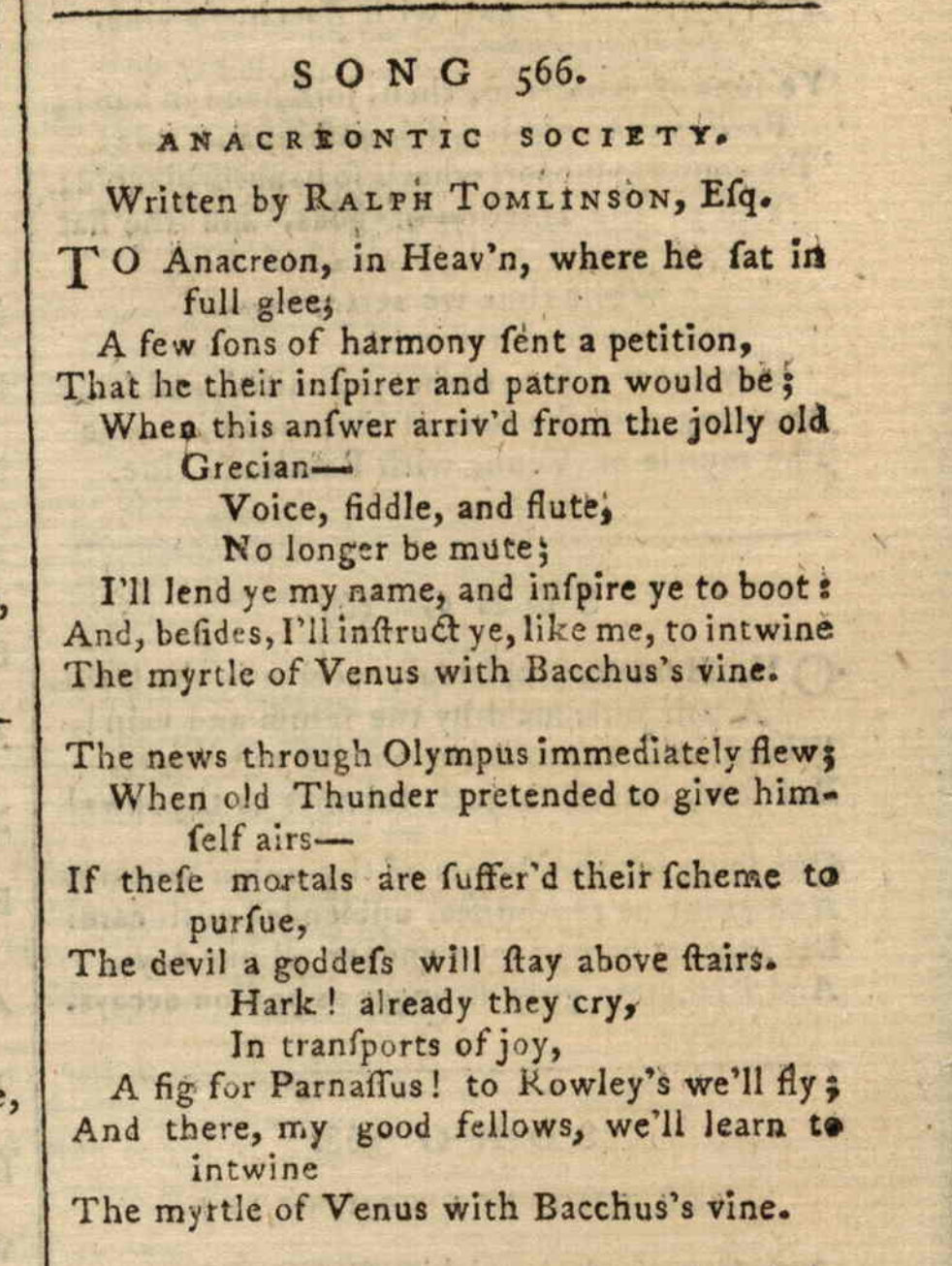
"To Anacreon in Heaven" (commonly called the Anacreontic Song) was a popular convivial song associated with a London gentlemen's musical club known as the Anacreontic Society. The melody was composed in the late 18th century by British musician John Stafford Smith for performance at the society's gatherings. The lyrics praise Anacreon, an ancient Greek lyric poet famed for verses on love and wine, and the piece reflects the lighthearted, toasting spirit of the club.
Image gallery
7 Images




Origins and historical context
The Anacreontic Society brought together amateur musicians and gentlemen who enjoyed musical performance, conviviality, and occasional amateur composition. The club's identity drew on classical allusion: Anacreon (a Greek poet of the 6th century BCE) symbolized elegant drinking verses and amatory poetry. John Stafford Smith supplied a melody that matched the society's spirited character, and the tune quickly circulated beyond the club in printed and oral forms, becoming a recognizable drinking-song air across Britain and its cultural sphere.
Music, lyrics, and performance
Musically, the Anacreontic tune is lively and singable, designed for group singing and toast-making. The original lyrics mix classical reference with comic praise of wine, lovers, and social merriment. Because of its accessible shape and memorable refrain, the melody was often adapted with new words for different occasions, a common practice in the 18th and 19th centuries when popular melodies circulated widely through broadsheets and personal performance.
Uses and legacy
The most historically consequential reuse of the melody occurred in the United States. In 1814 Francis Scott Key wrote the poem "Defence of Fort McHenry" after witnessing a British naval bombardment; the words were soon set to the familiar Anacreontic tune and circulated as a patriotic song. That pairing eventually became popularly known as "The Star-Spangled Banner." Over the following century the song grew in prominence and was formally designated the national anthem by the U.S. Congress in 1931. See also Francis Scott Key, The Star-Spangled Banner, national anthem and its association with the United States.
Notable facts and distinctions
- The tune began as a convivial club song and was not intended as a patriotic march, which has influenced later commentary about its suitability for the formal demands of a national anthem.
- Throughout the 19th century the melody continued to appear with different sets of lyrics—political, humorous, and commemorative—reflecting its flexibility and popularity.
- While "To Anacreon in Heaven" itself is less frequently sung today, its melody remains one of the best-known tunes in popular Western music because of its role in the American patriotic repertoire.
For readers wishing to trace original editions, performances, and lyrical variants, specialized music libraries and historic song collections document many versions and parodies of the Anacreontic tune and its migration from clubroom entertainment to national symbolism.
Related articles
Author
AlegsaOnline.com To Anacreon in Heaven (Anacreontic Song) Leandro Alegsa
URL: https://en.alegsaonline.com/art/100182