
The Word for World Is Forest
A short science‑fiction work by Ursula K. Le Guin, set in the Hainish universe. It examines colonialism, environmental destruction and cultural conflict on a forested planet and remains widely discussed.
Overview
The Word for World Is Forest is a short science‑fiction work by Ursula K. Le Guin set in the author’s shared Hainish universe. First published in the early 1970s, it can be read on its own or as part of the larger cycle. The story contrasts human colonists with an indigenous, forest‑dwelling people and uses that encounter to explore political and ethical questions central to Le Guin’s fiction. More bibliographic information is available through general references to the book and its editions (novel information, publication details).
Image gallery
2 Images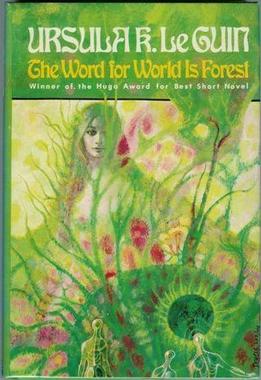
Setting and narrative
The action takes place on a heavily forested world inhabited by a people whose language and culture are intimately tied to the trees and the land. Human settlers exploit the planet for timber and resources, bringing military force, different values, and ecological disruption. Tension escalates as the native inhabitants react to exploitation; a central native figure emerges as a leader of resistance. The tale is compact and concentrated, focused on the consequences of contact rather than on complex plot mechanics.
Themes and style
Le Guin treats themes of colonialism, ecological destruction, and the ethics of violence and resistance. Language and perception are important motifs: the novel’s title gestures at the way a community’s vocabulary reflects its relationship to the environment. The prose mixes anthropological observation with moral inquiry, reflecting Le Guin’s long‑standing interest in cultural difference and human psychology.
Features and notable aspects
- Length and form: novella‑length work, often discussed alongside Le Guin’s other Hainish stories.
- Perspective: emphasizes the viewpoint of the colonized as well as the colonizers.
- Thematic focus: environmental ethics, indigenous resistance, and the costs of conquest.
Reception and legacy
The story attracted attention on publication for its timely engagement with anti‑war and environmental concerns and has remained a frequent subject of literary and critical study. It is taught in courses on science fiction, ecological literature, and postcolonial criticism. Readers approaching the book today often note its continuing relevance to debates about resource extraction, military occupation, and cultural survival within global contexts such as those discussed in the broader Hainish cycle (Hainish Cycle).
Further reading
For general introductions and bibliographic entries consult standard sources and author bibliographies listed under Le Guin’s name (Ursula K. Le Guin) and the work’s publication history (publication details, novel information). Academic discussions and critical essays explore its themes in depth and connect the story to later environmental and anti‑colonial literature.
Related articles
Author
AlegsaOnline.com The Word for World Is Forest Leandro Alegsa
URL: https://en.alegsaonline.com/art/99135