
The Happiest Millionaire (1967 film)
A 1967 Walt Disney musical film based on Cordelia Drexel Biddle’s memoir. The Sherman Brothers wrote the songs; Bill Thomas received an Academy Award nomination for costume design. It was produced during Walt Disney's final years.
The Happiest Millionaire is a 1967 musical film produced by Walt Disney's studio and inspired by the real-life story of Philadelphia social figure Anthony J. Drexel Biddle. Presented as a lighthearted period piece, the film adapts material drawn from Cordelia Drexel Biddle's memoir and a subsequent stage adaptation. Its music was written by the Sherman Brothers, whose melodies and lyrics shaped the film's tone and many of its set-piece numbers.
Image gallery
1 Image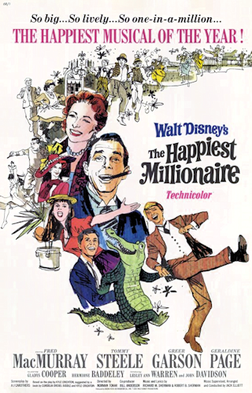
Background and source material
The cinematic story traces its origins to the recollections of Cordelia Drexel Biddle, who published a memoir about her father and his household. That book was dramatized for the stage and later adapted for the screen. The screenplay for the film translates the episodic, family-centered anecdotes of early 20th-century Philadelphia into musical scenes that emphasize character eccentricities, social rituals, and domestic comedy.
Production and music
The project was undertaken by Walt Disney's film division during the mid-1960s and is often remembered as one of the last major live-action musical comedies associated with Disney's personal oversight; Walt Disney died while the film was in production. The score and songs were supplied by Robert and Richard Sherman, longtime collaborators with the studio, and the film employed elaborate period costumes and production design. The costume designer received an Academy Award nomination for the film's wardrobe, reflecting its emphasis on era detail and theatrical presentation.
Themes, style and reception
The Happiest Millionaire blends nostalgic portraiture with broad musical comedy. Themes include family loyalty, social status, and the clash between tradition and modern manners. Contemporary critics and audiences received the film with mixed reactions: some praised its craftsmanship and musical numbers, while others found its pacing and narrative structure uneven. Over time it has remained of interest to collectors and fans of classic studio-era musicals.
Legacy and notable facts
Notable aspects of the film include its role in the late-1960s catalog of Disney live-action features, the Sherman Brothers' original songs, and its recognition for costume design. The production exemplifies a transitional moment in American studio musicals and is often cited when discussing Walt Disney's final projects. For more about the studio's involvement and broader context, see materials associated with Walt Disney.
- Source: adaptation of a memoir and stage play.
- Music: score and songs by the Sherman Brothers.
- Awards: nomination for costume design.
- Historical note: produced during Walt Disney's lifetime; he died during production.
Related articles
Author
AlegsaOnline.com The Happiest Millionaire (1967 film) Leandro Alegsa
URL: https://en.alegsaonline.com/art/98123