
Tai languages
Branch of the Kra–Dai family spoken across Southeast Asia and southern China; includes Thai and Lao. Tonal, analytic, and forming a dialect continuum with several writing traditions and sociolinguistic roles.
Overview
The Tai languages form a major branch of the broader Kra–Dai family and are spoken across much of mainland Southeast Asia and parts of southern China. They include national and regional varieties such as Thai and Lao as well as numerous lesser-known languages and dialects. Together they constitute a continuum in which boundaries between distinct languages and dialects are often gradual rather than sharp.
Image gallery
5 Images


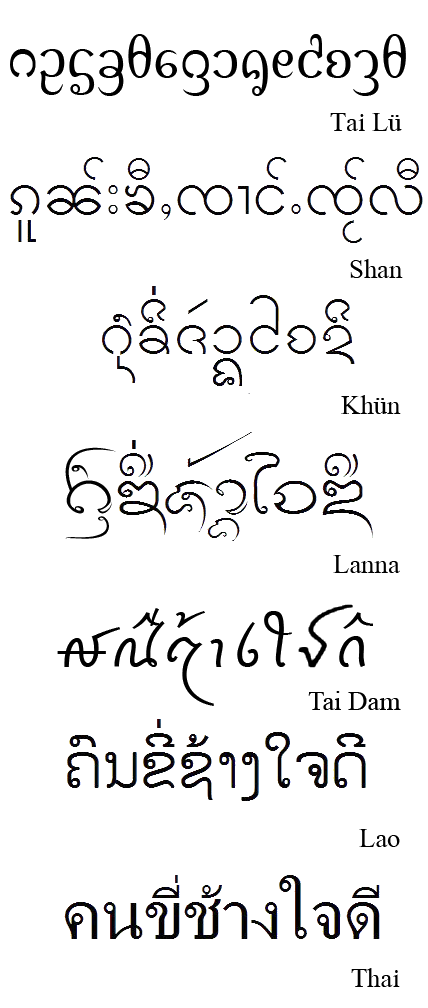
Characteristics
Tai languages are typically tonal, using pitch to distinguish lexical or grammatical meaning, and they are predominantly analytic, with little inflectional morphology. Typical sentence order is subject–verb–object and many languages employ classifiers with nouns. Many languages preserve monosyllabic roots and a rich system of vowel and consonant contrasts.
History and classification
Linguists reconstruct a Proto-Tai stage from which the present-day branches diversified. Historical research links earlier Tai-speaking populations to areas of southern China, followed by migrations and settlement across the Mekong basin and adjacent regions. The group sits within the Kra–Dai hypothesis and is often discussed in relation to neighboring families and contact phenomena.
Writing systems and literature
Several Tai languages possess long written traditions. The Thai and Lao scripts derive from Old Mon and Old Khmer Brahmic models, adapted to represent tone and phonology. Other languages use modified scripts or literacy efforts based on Latin or local orthographies for education and publishing.
Distribution and sociolinguistic notes
Major Tai languages function as national or regional lingua francas and are used in media, education, and administration, while many minority Tai varieties remain important for community identity. Language shift, standardization, and revitalization efforts vary by country. Mutual intelligibility can be high within geographic clusters (for example, central Thai and Lao), but differences in phonology, lexicon, and script often mark separate identities.
Further reading
Author
AlegsaOnline.com Tai languages Leandro Alegsa
URL: https://en.alegsaonline.com/art/95909