
Survivor Series (1988): WWF's second annual elimination tag team event
A summary of Survivor Series (1988), the World Wrestling Federation's second annual Thanksgiving-era pay-per-view held Nov 24, 1988 at Richfield Coliseum, focusing on format, context, and legacy.
Overview
Survivor Series (1988) was a professional wrestling pay-per-view produced by the World Wrestling Federation (WWF) and staged on November 24, 1988. The show took place at the Richfield Coliseum in Richfield Township, Ohio. As the second event in the Survivor Series chronology, it continued the franchise's emphasis on multi-competitor elimination tag matches and national television exposure for the promotion.
Image gallery
1 Image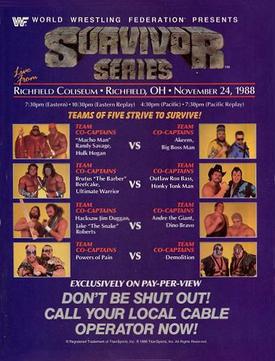
Format and characteristics
The Survivor Series concept centers on teams of wrestlers competing under elimination rules: a competitor is removed after being pinned, submitted, disqualified, or counted out, and the match continues until every member of one team has been eliminated. This format emphasizes teamwork, storytelling, and shifting in-ring dynamics as alliances and rivalries evolve during a single match. The 1988 card followed that template, featuring several team-versus-team eliminations rather than traditional singles title bouts.
Historical context
Introduced the previous year as a seasonal, Thanksgiving-weekend attraction, Survivor Series became part of the WWF's expanding pay-per-view schedule during the late 1980s. The promotion used these events to showcase large portions of its roster, advance ongoing storylines, and create memorable moments by pairing or opposing popular and rising stars. The WWF — later renamed WWE — used the Survivor Series brand as a recurring platform in its annual calendar.
Importance and reception
Survivor Series events were notable for their ensemble storytelling and for creating high-stakes scenarios without relying on championship matches. The 1988 edition continued to reinforce the model of themed pay-per-views that the WWF had been building, helping to solidify the promotion's national reach and the popularity of its larger-than-life characters. Fans and commentators often regard early Survivor Series cards as key examples of late-1980s sports-entertainment presentation.
Notable features and legacy
- Team elimination structure that distinguishes the event from standard single-match cards.
- Placement on the Thanksgiving weekend made it an annual television tradition for many viewers.
- Use of large indoor arenas, such as the Richfield Coliseum, to host nationwide audiences.
- Role in promoting the WWF roster and developing multi-person storylines.
For a broader understanding of the event type and promotion, see pages on professional wrestling, the pay-per-view model, the World Wrestling Federation (WWF) as the organizing promotion, and the Survivor Series series of events. Contemporary records and match lists provide detailed results and participant information for the 1988 card.
Questions and answers
Q: What was Survivor Series (1988)?
A: Survivor Series (1988) was a professional wrestling pay-per-view show produced by World Wrestling Federation (WWF).
Q: When was Survivor Series (1988) held?
A: Survivor Series (1988) was held on November 24, 1988.
Q: Where was the event held?
A: The event was held at the Richfield Coliseum in Richfield Township, Ohio.
Q: How many Survivor Series events had been held by the WWF before 1988?
A: The WWF had held one Survivor Series event prior to 1988.
Q: When was the first Survivor Series event held by the WWF?
A: The first Survivor Series event was held by the WWF in 1987.
Q: What was the main feature of Survivor Series events?
A: The main feature of Survivor Series events was the elimination-style tag team matches.
Q: How many tag teams were usually involved in the elimination-style matches at Survivor Series events?
A: Usually, four or five tag teams were involved in the elimination-style matches at Survivor Series events.
Related articles
Author
AlegsaOnline.com Survivor Series (1988): WWF's second annual elimination tag team event Leandro Alegsa
URL: https://en.alegsaonline.com/art/95227