
Stentor: the trumpet-shaped, regenerating ciliates
Overview of Stentor, a genus of large, horn-shaped freshwater ciliates: morphology, feeding, reproduction, regeneration, ecology, and their role in research and teaching.
Stentor is a distinctive genus of large, usually horn- or trumpet-shaped single-celled organisms classified among the heterotrich ciliates. Many Stentor species are visible without a microscope: some individuals reach about 1–2 millimetres in length, making them among the largest known unicellular eukaryotes. Their size, conspicuous shape and striking behaviour have made them familiar subjects in classical microscopy and modern cell biology.
Image gallery
5 Images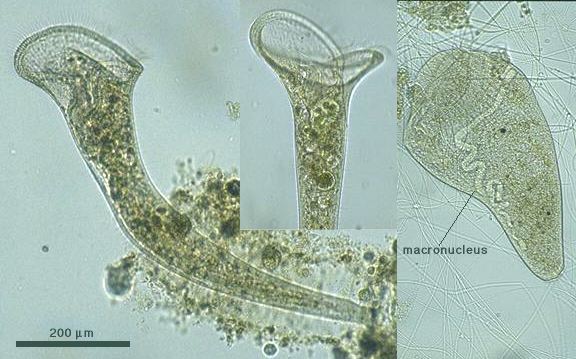


Morphology and internal organization
Typical Stentor cells are conical with a broad anterior "bell" and a tapered posterior end. The bell margin bears a prominent band of cilia (the peristomial cilia) that coordinates feeding currents and locomotion. The cell cortex is supported by a complex cytoskeletal network that helps maintain shape and allows the cell to contract or coil when disturbed. Internally each cell contains a large, often elongate macronucleus that controls everyday metabolic functions and one or more micronuclei involved in genetic exchange—this dual-nucleus arrangement is characteristic of ciliates.
Feeding and physiology
Stentor are heterotrophic filter feeders: coordinated ciliary beating draws bacteria, single-celled algae and small particles toward the oral region where food is ingested. As freshwater protozoans, they must cope with osmotic inflow of water. To maintain osmotic balance Stentor use a contractile vacuole to collect and expel excess water that enters by osmosis. Some species contain pigments—Stentor coeruleus, for example, often appears blue-green—while others are unpigmented or harbour symbiotic algae.
Reproduction, conjugation and regeneration
Reproduction is commonly asexual by binary fission, producing two daughter cells. Like other ciliates, Stentor can also undergo conjugation, a sexual process in which micronuclei are exchanged and genetic recombination occurs. A remarkable and historically significant property of Stentor is extreme regenerative ability: fragments of a cell, if containing part of the cortex and nuclear material, can frequently regenerate the full complement of structures and regenerate into a complete, functional organism. This capacity has made Stentor a classical model for studying morphogenesis and cellular patterning.
Habitat, ecology and distribution
Members of the genus Stentor are widespread in freshwater environments such as ponds, lakes, ditches and slow-moving streams. They may be free-swimming or temporarily attached to substrates like plants, stones or detritus, often using stalk-like contractions to anchor. In ecological terms they act as micro-predators and consumers of bacteria and small algae and can be important components of microbial food webs in standing waters.
Species, identification and notes
Well-known species include Stentor coeruleus (often blue-pigmented), Stentor roeselii and Stentor polymorphus; species are distinguished by pigmentation, shape, size, and details of the oral structure and ciliation. Identification to species may require careful microscopy and comparison with taxonomic keys. Older literature sometimes used the informal name "trumpet animalcules" for these organisms.
Research, teaching and historical significance
Because of their large size, visible organelles and dramatic regenerative responses, Stentor have long been used in teaching demonstrations and in experimental studies of cellular organization, regeneration and behaviour. They continue to be of interest in research on cell polarity, pattern formation and the cellular basis of memory and behaviour.
Further reading and resources
- General overviews of protists and their biology
- Introductions to ciliate structure and life cycles
- Osmoregulation and the contractile vacuole in freshwater protozoa
- Basic explanations of osmosis and membrane transport
- Taxonomic and nomenclatural references for the genus Stentor
Observers wishing to see Stentor can often find them in pond water or in samples of submerged vegetation; because they are large and robust, they can be observed with low-power microscopes and are useful for educational microscopy exercises. When reporting or studying Stentor, cautious species identification and reference to modern taxonomic sources are advisable, as classification of protists has been revised with molecular evidence in recent decades.
Author
AlegsaOnline.com Stentor: the trumpet-shaped, regenerating ciliates Leandro Alegsa
URL: https://en.alegsaonline.com/art/93730