
Spontaneous symmetry breaking
Phenomenon in which symmetric laws permit asymmetric states; central to phase transitions, collective modes (Goldstone bosons), the Higgs mechanism, and formation of topological defects.
Spontaneous symmetry breaking (SSB) is the phenomenon by which the equations or fundamental laws that describe a system are symmetric, while the state actually realized by the system is not. The symmetry of the underlying rules remains intact, but the system's equilibrium (or ground state) selects one among several equivalent possibilities, so that the observed configuration lacks the full symmetry of the laws. The selection often occurs when a control parameter—such as temperature, pressure, or coupling strength—passes a critical value and the symmetric solution becomes unstable.
Image gallery
1 Image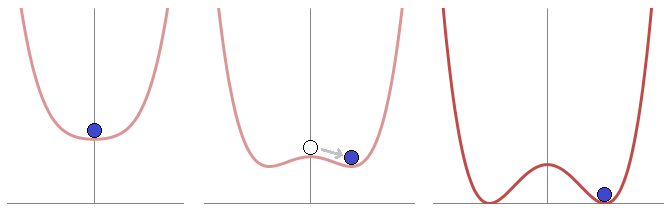
Core ideas
- Order parameter: a quantity that is zero in the symmetric phase and acquires a nonzero value when symmetry is broken (for example magnetization in a ferromagnet or the condensate amplitude in a superfluid).
- Degenerate ground states: the energy or free-energy landscape has multiple equivalent minima related by the symmetry; the choice of one minimum breaks the symmetry.
- Continuous vs discrete: breaking a continuous symmetry (such as rotations or phase invariance) leads to qualitatively different consequences than breaking a discrete symmetry (such as inversion).
- Criticality and fluctuations: near the transition small fluctuations and noise can determine which symmetry-related state is chosen; critical phenomena and universality classes describe the behavior close to the transition.
SSB was first clarified in statistical and condensed-matter contexts to describe transitions like ferromagnetism and superconductivity. It was later adopted in particle physics, where patterns of broken symmetry explain why some particles acquire mass while the underlying gauge symmetry governs interactions. For continuous global symmetries, the Nambu–Goldstone result implies low-energy collective excitations (Goldstone modes) associated with slow variations of the order parameter. When a broken symmetry is local (a gauge symmetry), the would-be Goldstone excitations are absorbed into gauge fields, giving those fields mass; this is the essence of the Higgs mechanism.
Topological consequences of SSB include defects that arise when different regions choose different minima: domain walls, vortices, strings and monopoles are classical examples encountered across condensed matter and cosmology. Whether such defects form and persist depends on dimensionality, topology of the order-parameter space, and the dynamics of the transition.
Distinguishing spontaneous from explicit symmetry breaking is important: explicit breaking appears as asymmetric terms in the fundamental description and removes exact degeneracy, while spontaneous breaking leaves the laws symmetric but produces asymmetric states. Finite-size effects, thermal fluctuations, quantum tunneling and external fields can blur the idealized distinction in experiments. Theoretical tools used to study SSB include Landau theory of phase transitions, effective field theories for low-energy modes, and renormalization-group methods for critical behavior.
Related articles
Author
AlegsaOnline.com Spontaneous symmetry breaking Leandro Alegsa
URL: https://en.alegsaonline.com/art/92782