
Solubility: how substances dissolve and mix in liquids
Solubility describes how much of a solute can dissolve in a solvent under given conditions. Covers definitions, types (miscible, saturated, supersaturated), factors, measures, examples and practical importance.
Solubility is the property that describes how much of one substance (the solute) can dissolve in another (the solvent) to form a homogeneous mixture called a solution. It is a conditional quantity: the amount that will dissolve depends on temperature, pressure and the chemical nature of both solute and solvent. Quantitative solubility may be expressed in units such as grams per 100 millilitres of solvent, molar concentration, or as a solubility equilibrium constant.
Image gallery
4 Images


Basic concepts and terminology
A solute is the substance being dissolved; a solvent is the medium doing the dissolving. In many laboratory contexts the solvent is a liquid and remains the component in larger amount. When a solute and solvent are present in proportions such that no more solute will dissolve under the current conditions, the solution is called saturated. If less solute is present than the saturation point, it is unsaturated. A solution containing more dissolved solute than would be stable at equilibrium is termed supersaturated; such solutions are metastable and often precipitate the excess solute on disturbance.
Types and common distinctions
- Miscibility: Two liquids are miscible if they dissolve in each other in all proportions (for example, ethanol and water are largely miscible). Miscibility is often used for liquid–liquid systems rather than for describing small amounts of one substance in another.
- Soluble vs sparingly soluble: Some solids dissolve readily in a solvent, while others dissolve only very little. These everyday adjectives reflect large differences in equilibrium concentrations.
- Gases: The solubility of gases in liquids behaves differently from solids and is strongly influenced by pressure above the liquid as described by Henry’s law.
Factors affecting solubility
Several factors control how much solute dissolves:
- Temperature: For many solids, solubility increases with temperature, but some compounds show the opposite trend. For gases, solubility in liquids typically decreases as temperature rises.
- Pressure: Pressure has little effect on the solubility of solids but significantly affects gas solubility; higher gas pressure increases the amount dissolved.
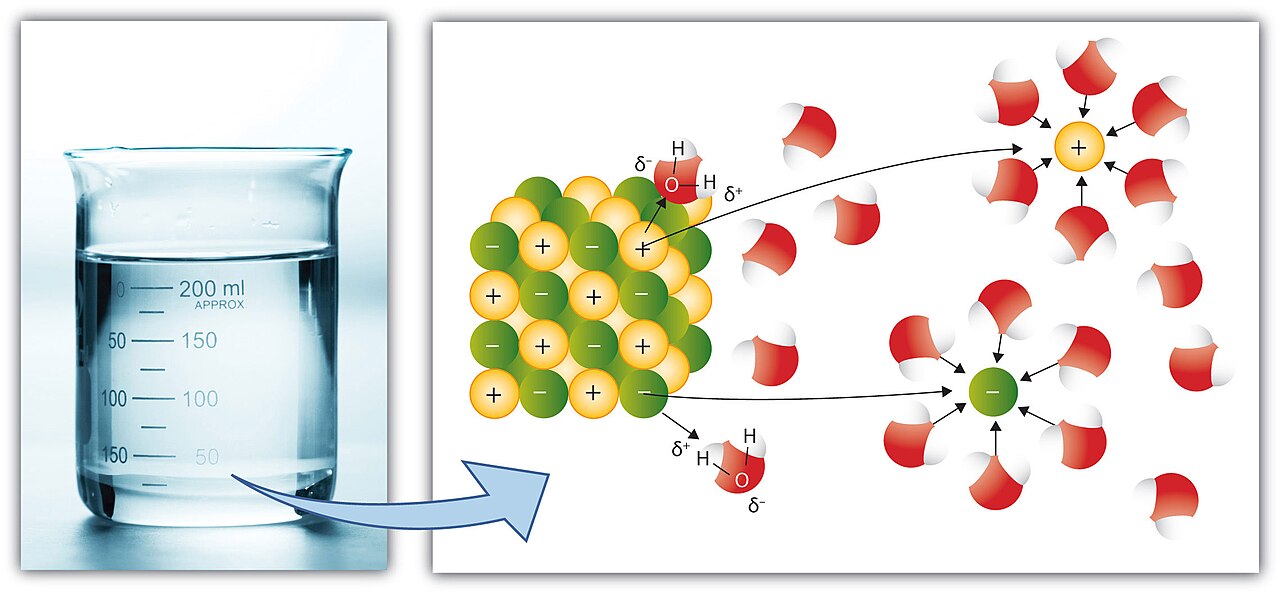
- Polarity and chemical interactions: "Like dissolves like" is a useful rule — polar solvents dissolve polar or ionic solutes, nonpolar solvents dissolve nonpolar solutes. Specific interactions such as hydrogen bonding or complex formation also alter solubility.
- Common-ion and pH effects: The presence of shared ions or changes in acidity can suppress or enhance solubility for ionic and acid–base sensitive substances.
How solubility is measured and modelled
Solubility is reported as a concentration (mass/volume or molarity) or as an equilibrium constant (for ionic salts the solubility product, Ksp). Experimental solubility curves show how solubility varies with temperature. Thermodynamic and kinetic models predict equilibrium concentrations and the rates at which dissolution or precipitation occur.
Practical importance and examples
Solubility is central in chemistry, biology, medicine and engineering. Drug delivery depends on the solubility of active molecules; environmental fate of pollutants depends on how they partition between water and other phases; industrial separations and crystallization processes rely on controlled solubility changes. Everyday examples include salt dissolving in water to make a brine, carbon dioxide dissolving in a carbonated beverage under pressure, and the miscibility of alcohols and water in many consumer products.
Notable facts and distinctions
- Solubility is an equilibrium property; dissolution also involves kinetics—how fast a substance dissolves can differ from how much will ultimately dissolve.
- Miscibility implies complete mutual solubility of liquids, while solubility often refers to the limited dissolution of a solid or gas in a liquid.
- Understanding solubility requires both qualitative chemical insight and quantitative measurement; models such as Ksp and Henry’s law provide frameworks for prediction.
For more introductory or technical discussions, see resources on solvents and solvent effects (solvent) and specific substance examples such as ethanol in water.
Related articles
Author
AlegsaOnline.com Solubility: how substances dissolve and mix in liquids Leandro Alegsa
URL: https://en.alegsaonline.com/art/91714